
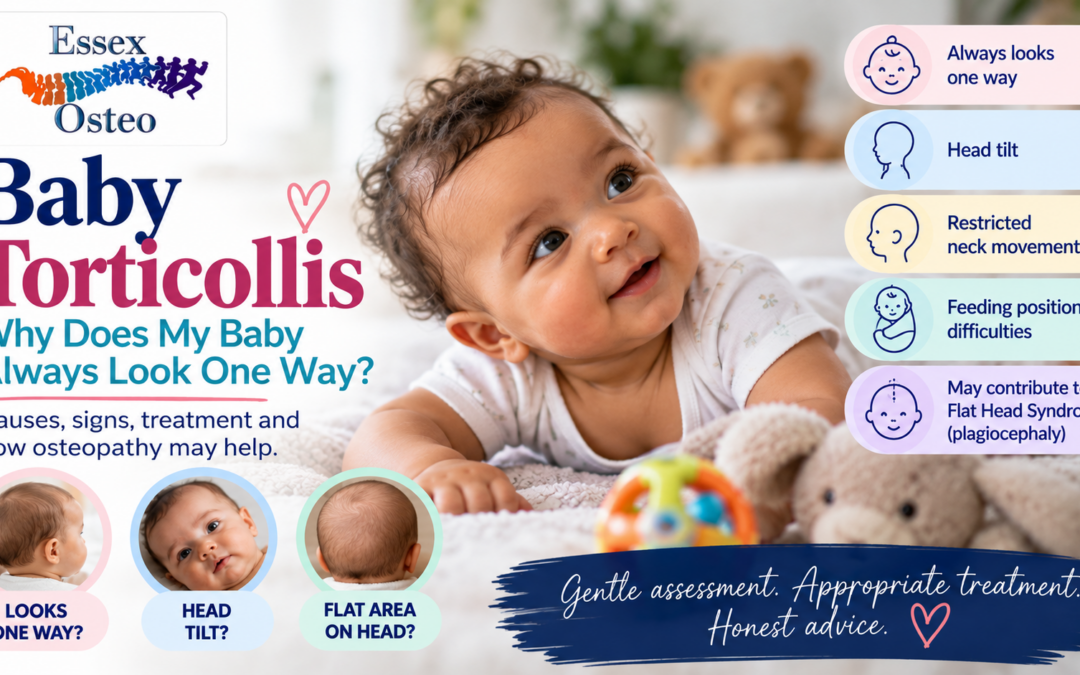
Baby Torticollis: Why Does My Baby Always Look One Way?
Causes, Signs, Treatment & How Osteopathy May Help
Have you noticed that your baby nearly always looks in the same direction? Perhaps their head seems tilted to one side, they find feeding easier on one breast or from one direction, or you’re beginning to notice a flat area developing on one side of their head.
One possible explanation is torticollis.
Torticollis in babies can affect how comfortably they turn their head and may contribute to a persistent positional preference. Early recognition is useful because appropriate positioning, exercises and treatment can help improve movement and reduce the likelihood of secondary problems such as positional plagiocephaly.
At Essex Osteo in Stanford-le-Hope, we provide gentle musculoskeletal assessment for babies with concerns about neck movement, head position and movement symmetry.
This guide explains what torticollis is, what parents should look for, when to seek professional advice and where osteopathy may fit alongside physiotherapy and paediatric healthcare.
What Is Torticollis in Babies?
Torticollis describes an abnormal position of the head and neck.
In babies, one of the most recognised forms is congenital muscular torticollis (CMT). This is commonly associated with the sternocleidomastoid (SCM) muscle on one side of the neck.
A baby with torticollis may typically:
- Tilt their head towards one shoulder
- Turn their face towards the opposite side
- Prefer looking in one direction
- Have reduced neck movement
- Become uncomfortable when encouraged to look the other way
The degree of restriction can vary considerably.
Some babies have an obvious head tilt, while in others the first thing parents notice is simply:
“My baby always looks to the same side.”
Why Does My Baby Always Look One Way?
A positional preference doesn’t automatically mean your baby has torticollis.
During the first few weeks, babies may temporarily favour one direction.
However, if your baby consistently looks the same way and rarely turns comfortably in the opposite direction, it is worth mentioning to your health visitor, GP or an appropriately trained musculoskeletal professional.
Possible reasons include:
- Congenital muscular torticollis
- Muscular tightness
- Positional preference
- Reduced neck movement
- Environmental positioning
- Visual or hearing factors
- Other less common medical or neurological causes
This is why assessment is preferable to simply assuming the neck is “tight”.
What Does Torticollis Look Like?
Parents may notice several signs.
Baby Always Turns Their Head One Way
Your baby may repeatedly return to their preferred position even after you gently encourage them to look the other way.
Head Tilt
One ear may appear closer to the shoulder than the other.
Difficulty Turning the Head
Your baby may comfortably look one way but appear reluctant or unable to rotate fully in the opposite direction.
Feeding Preference
Some babies appear more comfortable feeding from one side because of the position required of their neck.
This doesn’t necessarily mean that a feeding problem is caused by torticollis, but neck movement is one factor worth considering.
Flattening of the Head
Repeatedly lying with the head facing the same direction can increase pressure on one area of the skull.
Over time this may contribute to positional plagiocephaly, commonly called flat head syndrome.
Torticollis and Flat Head Syndrome
Torticollis and plagiocephaly can sometimes occur together.
If a baby finds it easier to look towards the right, for example, they may spend considerably more time resting on the same part of the back of their head.
This repeated pressure may contribute to flattening.
Likewise, once a positional preference becomes established, a baby may continue favouring that position.
This is one reason why early recognition of restricted neck movement can be helpful.
You can read our dedicated guide: Flat Head Syndrome (Plagiocephaly): Causes, Treatment & How Osteopathy May Help Your Baby.
What Causes Torticollis in Babies?
There isn’t always one obvious cause.
Congenital muscular torticollis may be associated with factors occurring before or around birth, but parents should not assume that somebody did something wrong during delivery.
Potential associations include:
- Position in the uterus
- Multiple pregnancy
- Reduced space during pregnancy
- Breech presentation
- Difficult or prolonged labour
- Assisted delivery
However, an assisted birth does not automatically cause torticollis, and most babies born using forceps or ventouse will not develop it.
Can Forceps or Ventouse Cause a Baby’s Stiff Neck?
Parents understandably make this connection when symptoms appear after an assisted delivery.
A baby’s birth history is relevant and should be discussed during assessment.
However, it is overly simplistic to say that forceps or ventouse have “put the baby’s neck out”.
At Essex Osteo, we assess the baby’s current movement and function rather than assuming treatment is required purely because of how they were born.
Is My Baby’s Neck “Out of Alignment”?
This is another phrase parents may encounter online.
A baby’s neck does not routinely need to be “put back into alignment” after birth.
Torticollis is better understood by considering factors such as:
- Range of movement
- Muscle function
- Head position
- Movement preference
- Development
- Associated head shape
Treatment should focus on these measurable findings rather than frightening parents with the suggestion that their baby’s spine is misplaced.
How Is Baby Torticollis Assessed?
Assessment begins with a detailed history.
We may ask about:
- Pregnancy
- Position during pregnancy
- Birth
- Assisted delivery
- Feeding
- Sleeping
- Tummy time
- When you first noticed the preference
- Whether it is improving or worsening
- Your baby’s general health and development
We then observe how your baby naturally moves.
What Do We Look For?
Assessment may consider:
Head Position
Is there an obvious tilt?
Neck Rotation
Can your baby comfortably look left and right?
Side Bending
Is movement similar in both directions?
Muscle Function
Does one side appear tighter or function differently?
Head Shape
Is there evidence of positional flattening?
General Movement
Does your baby use both sides of their body appropriately?
Development
Is movement appropriate for their age?
These findings help determine whether treatment, home advice, monitoring or referral is appropriate.
Can Osteopathy Help Baby Torticollis?
Osteopathic care may form one part of the management of some babies with musculoskeletal neck restriction.
Treatment should be gentle and based on assessment.
Depending on the findings, management may include:
- Gentle manual techniques
- Encouraging comfortable neck movement
- Positioning advice
- Supervised tummy-time advice
- Guidance on carrying positions
- Home exercises where appropriate
- Monitoring head shape and movement
The aim is not to “click” or force a baby’s neck.
Treatment should be comfortable and age appropriate.
What About Physiotherapy for Torticollis?
Physiotherapy has an important role in managing congenital muscular torticollis.
A paediatric physiotherapist may provide:
- Specific stretching
- Strengthening
- Positioning strategies
- Developmental exercises
- Monitoring of motor development
Depending on your baby’s presentation, physiotherapy may be recommended either instead of or alongside osteopathic management.
Good care is about choosing the right professional for the baby, rather than assuming one profession should manage every case.
What Can Parents Do at Home?
There are several ways parents can encourage varied movement during normal daily activities.
Encourage Looking Towards the Non-Preferred Side
When your baby is awake, position interesting things on the side they are less likely to look towards.
This could include:
- Your face
- Toys
- Lights
- Activity mats
- Interesting sounds
Never force your baby’s head.
The goal is to encourage active movement.
Supervised Tummy Time
Tummy time is important for developing:
- Neck strength
- Shoulder strength
- Upper-body control
- Early motor skills
It also reduces the amount of awake time spent with pressure on the back of the head.
If your baby initially dislikes tummy time, try shorter, more frequent periods.
Tummy time should only occur while your baby is awake and supervised.
Change Your Position During Feeding
If appropriate for your feeding method, changing positions can encourage your baby to turn their head in different directions.
If feeding is difficult, seek appropriate infant-feeding support rather than repeatedly forcing an uncomfortable position.
Vary Carrying Positions
Holding your baby in different safe positions can provide opportunities for varied head and neck movement.
Think About the Environment
Babies are naturally attracted to:
- Parents
- Windows
- Lights
- Movement
- Sounds
If all the interesting activity consistently occurs on one side of the cot or changing area, your baby may naturally keep turning that way.
Simple environmental changes can encourage movement in both directions.
What About Sleep Position?
This is important.
Babies should continue to be placed on their backs for sleep.
Do not use pillows or positioning devices to hold a baby’s head in a particular position while sleeping unless specifically advised by an appropriate medical professional.
Safe-sleep guidance takes priority over attempts to change head shape.
How Quickly Does Torticollis Improve?
This varies.
Factors influencing recovery may include:
- Severity of restriction
- Age when recognised
- Presence of plagiocephaly
- Underlying cause
- Consistency with home advice
- Other developmental or medical factors
Some mild positional preferences improve relatively quickly, while more established torticollis may require ongoing rehabilitation and monitoring.
There should not be a predetermined number of osteopathic treatments for every baby.
When Should I Seek Medical Advice?
Most positional neck problems are not medical emergencies.
However, a baby with an unusual head position should be appropriately assessed, particularly if the problem:
- Appeared suddenly
- Is becoming worse
- Is associated with significant pain or distress
- Is accompanied by unusual eye movements
- Follows an injury
- Occurs alongside weakness or abnormal movement
- Is associated with developmental concerns
- Is accompanied by your baby being generally unwell
A new or sudden-onset torticollis is different from a longstanding positional preference and deserves appropriate medical assessment.
Frequently Asked Questions About Baby Torticollis
Will torticollis go away on its own?
Some mild positional preferences may improve as babies become more active, but established torticollis should not simply be ignored. Early assessment can identify whether exercises, positioning advice, physiotherapy or other management is appropriate.
Can torticollis cause a flat head?
A persistent head-turning preference can contribute to positional plagiocephaly because the baby repeatedly rests on the same part of their head.
Can osteopathy cure torticollis?
It is more appropriate to discuss improving movement and function rather than promising a cure. Osteopathic care may form part of management for some babies, alongside home exercises or paediatric physiotherapy where appropriate.
Does my baby need cranial osteopathy?
Not necessarily. Treatment should be based on the baby’s individual findings rather than automatically recommending cranial treatment.
Should I stretch my baby’s neck myself?
Parents may be taught appropriate exercises by a suitably qualified healthcare professional. Avoid forceful stretching or copying exercises from social media without an assessment.
Is torticollis painful for babies?
Some babies appear comfortable despite their positional preference, while others may become unsettled when moved towards their restricted direction.
When should I get my baby’s neck checked?
If your baby consistently looks one way, has an obvious head tilt, struggles to turn their head or is developing a flat area on their head, it is sensible to discuss this with an appropriate healthcare professional.
Baby Torticollis Assessment in Stanford-le-Hope
If you’ve noticed that your baby:
👶 Always looks in one direction
👶 Has a persistent head tilt
👶 Finds turning one way difficult
👶 Appears more comfortable feeding from one side
👶 Is developing a flat area on their head
a gentle musculoskeletal assessment may help determine why.
At Essex Osteo, we’ve been providing osteopathic care since 1998 from our clinic in Stanford-le-Hope, Essex.
Our approach to babies is based on:
Gentle assessment. Appropriate treatment. Honest advice.
If another healthcare professional, such as your GP, health visitor or paediatric physiotherapist, is better placed to manage your baby’s problem, we’ll advise you accordingly.
We welcome families from Stanford-le-Hope, Corringham, Grays, Thurrock, Basildon, Tilbury, South Ockendon and surrounding areas of Essex.
If you’re searching for a baby osteopath near me, baby torticollis treatment in Stanford-le-Hope, or help because your baby always looks one way in Thurrock or Essex, contact Essex Osteo to discuss an appointment.
Essex Osteo – gentle osteopathic care for you and your growing family.