
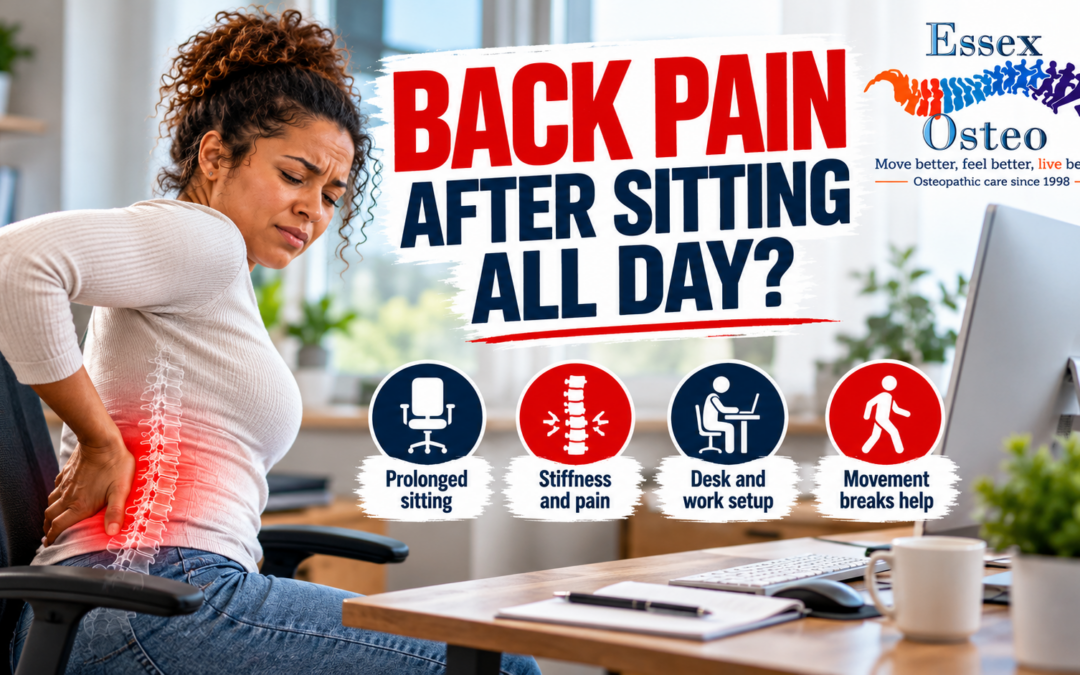
Back Pain After Sitting All Day
Why Sitting Can Aggravate Lower Back Pain – and What You Can Do About It
Do you feel reasonably comfortable when you start work, but by lunchtime your lower back is aching?
Perhaps your back becomes stiff after driving, working from home or spending several hours at a desk. When you finally stand up, you may need a few moments before you feel as though you can straighten properly.
At Essex Osteo in Stanford-le-Hope, we regularly see people who describe exactly this problem.
The good news is that experiencing back pain after sitting doesn’t necessarily mean sitting is damaging your spine.
Often, the issue isn’t simply how you sit.
It may be how long you remain in one position, how physically active you are during the rest of the day, and how well your body is currently able to tolerate prolonged sitting.
Let’s look at why.
Why Does My Back Hurt After Sitting?
Sitting itself isn’t inherently bad for your back.
The human body is capable of sitting, standing, bending, twisting and moving through many different positions.
However, staying in almost any position for several hours can become uncomfortable.
During prolonged sitting, you may experience:
- Reduced movement through the lower back
- Reduced movement through the hips
- Sustained loading of muscles and joints
- Muscle fatigue
- Temporary stiffness
- Increased sensitivity in an already irritable back
This can explain why you might feel comfortable for the first 30 minutes but increasingly uncomfortable several hours later.
The solution isn’t necessarily finding the perfect sitting posture.
Often, your back simply wants you to move.
Is Sitting Bad for Your Spine?
This is an important distinction.
Feeling uncomfortable while sitting doesn’t automatically mean you’re damaging your spine.
People sometimes become worried because they’ve been told that sitting:
- Compresses their discs
- Causes slipped discs
- Damages the spine
- Causes degeneration
- Permanently changes their posture
The reality is more complicated.
Our spinal tissues are designed to tolerate load, and normal daily activities expose the spine to different forces throughout the day.
If sitting produces symptoms, it may be useful to change how long you sit, vary your position and improve your overall physical capacity rather than viewing sitting itself as dangerous.
Is Poor Posture Causing My Back Pain?
Probably not in the simple way that is often suggested.
For years, people with back pain were frequently told to:
“Sit up straight.”
But there isn’t one universally correct sitting posture that prevents back pain.
You might be perfectly comfortable sitting upright for a while and then prefer leaning back.
At another time, you may naturally lean forward.
That’s normal.
Rather than trying to hold one rigid position throughout the working day, it may be better to use a variety of comfortable positions.
A useful principle is:
Your best posture may be your next posture.
Movement and variation often matter more than attempting to maintain a supposedly perfect position for eight hours.
Why Does My Back Hurt When I Stand Up After Sitting?
This is extremely common.
After sitting for a prolonged period, some people notice:
- Lower back stiffness
- Difficulty straightening initially
- Aching across the belt line
- Pain on one side of the back
- Buttock discomfort
- Temporary pain during the first few steps
After walking around for a few minutes, things may begin to loosen.
This doesn’t necessarily mean anything has moved out of place.
Your muscles and joints have simply spent a prolonged period in one position and may temporarily feel stiff or sensitive when you begin moving again.
Why Does My Back Hurt at My Desk?
Several factors may contribute.
1. Sitting for Too Long
The most obvious factor is simply duration.
Someone may spend:
- 7–8 hours working
- 1–2 hours commuting
- An evening watching television
and realise they’ve spent the majority of their waking day sitting.
Breaking up sitting time can therefore be useful.
2. Your Desk Setup
Although there is no perfect posture, your workstation should still be reasonably comfortable.
A poor setup may force you into a position you don’t tolerate well for long periods.
Consider:
- Screen height
- Chair height
- Keyboard position
- Mouse position
- Desk height
- Foot support
Your workstation should allow you to change position rather than locking you into one posture.
3. Working From a Laptop
Laptop working can be particularly challenging because the screen and keyboard are attached.
If the keyboard is at a comfortable height, the screen may be too low.
If the screen is raised, the keyboard may become awkward.
For prolonged laptop use, consider:
- Raising the laptop
- Using a separate keyboard
- Using a separate mouse
- Changing working position regularly
The aim isn’t perfection.
It’s making your working environment comfortable and adaptable.
4. Reduced Physical Activity
Sometimes the bigger issue isn’t the eight hours spent sitting.
It’s what happens during the other sixteen.
If work is sedentary and evenings are also largely inactive, overall physical activity can become quite low.
Regular exercise can help maintain:
- Strength
- Cardiovascular fitness
- Mobility
- General physical capacity
You don’t necessarily need complicated corrective exercises.
Walking regularly can be an excellent place to start.
5. Reduced Strength and Conditioning
People who experience recurrent back pain sometimes gradually become less active.
Pain leads to less activity.
Less activity reduces physical capacity.
Everyday tasks then become relatively more demanding.
This doesn’t mean everyone with back pain has a “weak core”.
However, appropriately progressing general strength and conditioning can be an important part of managing recurrent symptoms.
6. Previous Back Pain
If your back is already sensitive following a recent episode, prolonged sitting may aggravate symptoms more easily.
This doesn’t necessarily mean you’re causing additional damage every time it aches.
It may simply mean your current sitting tolerance is lower.
That tolerance can often be gradually rebuilt.
Back Pain After Driving
Driving combines several factors that can aggravate an irritable back:
- Prolonged sitting
- Limited opportunity to change position
- Vibration
- Repeated clutch or pedal use
- Getting in and out of the vehicle
- Long journeys without breaks
If you’re driving long distances, taking sensible breaks to stand and walk may help.
Adjust your seat so that you’re comfortable and can reach the controls without excessive effort.
Again, there isn’t one magical driving position.
Comfort and variation are key.
Should I Use a Standing Desk?
Standing desks can be useful—but they aren’t a cure for back pain.
Replacing eight hours of sitting with eight hours of standing simply replaces one prolonged posture with another.
A better strategy may be:
Sit → stand → walk → sit → move again.
A sit-stand desk can make this easier.
But you don’t necessarily need expensive equipment.
Regularly getting out of your chair may achieve much of the same objective.
How Often Should I Get Up From My Desk?
There isn’t one scientifically perfect interval that everyone needs to follow.
Rather than becoming obsessed with a stopwatch, try building movement naturally into your working day.
For example:
- Stand during some phone calls
- Walk to speak to a colleague
- Get water regularly
- Walk during lunch
- Change position during meetings
- Use the stairs
- Take brief movement breaks
If your back starts becoming uncomfortable after around an hour, don’t routinely wait two hours before moving.
Learn what your body currently tolerates and gradually build from there.
What Exercises Help Back Pain From Sitting?
There is no single “best” exercise for everyone.
However, many people benefit from combining movement with general strengthening.
Examples might include:
Walking
Simple, accessible and easy to build into the working day.
Gentle lumbar movement
Moving the lower back through comfortable ranges can help reduce the feeling of stiffness after prolonged sitting.
Hip movement
Squats, lunges or simple hip mobility exercises may help maintain movement after long periods at a desk.
Glute strengthening
Exercises such as bridges, squats and appropriately progressed resistance exercises can improve general lower-limb and hip strength.
Resistance training
A well-designed strengthening programme can gradually increase your ability to tolerate work, exercise and everyday activities.
The right exercises depend on your symptoms, health, goals and current level of fitness.
Should I Stretch My Back?
Stretching can feel helpful, particularly after you’ve been sitting for a long time.
But you don’t necessarily need to stretch constantly.
If stretching gives temporary relief but your symptoms repeatedly return, consider the bigger picture.
You may also need to address:
- Overall activity
- Strength
- Exercise tolerance
- Work habits
- Sleep
- Recovery
Stretching can be one tool rather than the entire solution.
Should I Buy a Special Office Chair?
Not necessarily.
An expensive ergonomic chair won’t automatically prevent back pain.
A comfortable, adjustable chair can certainly make working easier, but even the best chair cannot compensate for remaining almost completely stationary throughout the day.
Before spending hundreds of pounds, consider whether you can:
- Adjust your existing chair
- Improve your screen position
- Use a separate keyboard
- Change position more frequently
- Take regular movement breaks
- Increase your overall activity
Sometimes the simplest changes are the most practical.
Does Sitting Cause a Slipped Disc?
Back pain after sitting doesn’t automatically mean you have a slipped or herniated disc.
Disc changes are common and don’t always cause symptoms.
Disc-related pain can occur, and some people with disc or nerve-root irritation find sitting particularly uncomfortable.
However, diagnosis shouldn’t be based solely on the fact that sitting hurts.
A proper assessment should consider your complete symptom pattern and clinical examination.
What If Sitting Causes Sciatica?
If sitting produces pain travelling from the back or buttock into the leg, particularly with tingling, numbness or weakness, irritation of a spinal nerve may need to be considered.
This doesn’t automatically mean you need an MRI.
Many episodes of sciatica can initially be assessed clinically.
However, progressive neurological symptoms require appropriate medical assessment.
You can read our separate guide to Sciatica: Causes, Symptoms and Treatment for more information.
Do I Need an MRI for Back Pain From Sitting?
Usually not.
For uncomplicated lower back pain without concerning features, imaging is generally not routinely required.
MRI findings such as disc degeneration and disc bulges are common, including among people without back pain.
Imaging becomes more relevant when the result is likely to change management or when there are concerning neurological or medical features.
Read our guide: Do I Need an MRI for Back Pain?
When Should Back Pain After Sitting Be Assessed?
Consider seeking professional assessment if your symptoms:
- Persist despite sensible self-management
- Are becoming progressively worse
- Frequently interfere with work
- Repeatedly return
- Prevent normal activity
- Are accompanied by persistent leg symptoms
- Include numbness or weakness
- Are causing significant concern
A good assessment should look beyond simply asking where it hurts.
When Could Back Pain Be Serious?
Most sitting-related back pain isn’t caused by serious disease.
However, urgent medical assessment is required for symptoms such as:
🚩 New loss of bladder or bowel control
🚩 Numbness around the genitals, anus or inner thighs
🚩 Significant or progressive weakness in the legs
🚩 Severe symptoms following significant trauma
Other features such as unexplained weight loss, fever, significant night pain, history of cancer or systemic illness may also warrant medical assessment depending on the clinical circumstances.
If you’re unsure, seek appropriate medical advice.
Can Osteopathy Help Back Pain From Sitting?
For appropriate musculoskeletal back pain, osteopathic care may form one part of a broader management plan.
At Essex Osteo, assessment may include your:
- Lower back
- Hips
- Movement
- Neurological function where appropriate
- Work demands
- Exercise levels
- Previous episodes
- Current physical capacity
Management may then include:
- Joint mobilisation
- Manipulation where appropriate
- Soft tissue techniques
- Dry needling where appropriate
- Movement advice
- Exercise
- Progressive strengthening
- Rehabilitation
- Self-management strategies
Hands-on treatment may help some people manage symptoms, but we don’t believe the answer to desk-related back pain is simply having your back repeatedly “put back into place”.
The longer-term goal is to help you move confidently and become less dependent on treatment.
7 Practical Things to Try Tomorrow
If your back becomes uncomfortable during a working day, try:
- Change position more frequently rather than searching for one perfect posture.
- Get out of your chair regularly, even if only briefly.
- Take a walk at lunchtime rather than remaining at your desk.
- Check your workstation is comfortable rather than rigidly “perfect”.
- Increase your general physical activity outside work.
- Include appropriate strengthening exercise during the week.
- Build your sitting tolerance gradually if you’ve recently experienced back pain.
Small changes repeated consistently may be more useful than completely redesigning your workstation.
Frequently Asked Questions
Why does my lower back hurt after sitting for 30 minutes?
Prolonged sitting can become uncomfortable when your back is sensitive or isn’t currently accustomed to remaining in one position for that long. The precise cause varies between individuals, so persistent symptoms may benefit from assessment.
Is sitting cross-legged bad for my back?
Not necessarily. If it’s comfortable, sitting cross-legged isn’t automatically harmful. As with other positions, staying there for a prolonged period may eventually become uncomfortable.
Should I sit completely upright?
You don’t need to maintain a rigid upright posture all day. Comfortable variation is generally more practical than trying to hold one “perfect” posture.
Is a standing desk better for back pain?
It can help you vary your working position, but standing continuously isn’t necessarily better than sitting continuously. Alternating between sitting, standing and moving is often more useful.
Should I use lumbar support?
Some people find lumbar support comfortable, particularly while driving or during prolonged sitting. It isn’t compulsory and doesn’t correct a supposedly damaged spine.
Can weak core muscles cause sitting-related back pain?
Back pain is rarely explained by one muscle group alone. Strengthening can be helpful, but recurrent pain shouldn’t automatically be blamed on a “weak core”.
Should I stop sitting if my back hurts?
Usually, complete avoidance isn’t necessary. It may be more useful to temporarily reduce prolonged sitting, change position regularly and gradually rebuild your tolerance.
Back Pain From Sitting? We Can Assess What’s Going On
If you’re constantly shifting in your chair, struggling after long drives or finding that your back becomes increasingly painful throughout the working day, it may be worth having it assessed.
At Essex Osteo in Stanford-le-Hope, we can assess your symptoms, movement and physical demands and discuss whether treatment, rehabilitation or changes to your daily routine may help.
Our aim isn’t simply to make your back feel better for a few days.
It’s to help you understand the problem, improve your physical capacity and give you practical strategies for managing it yourself.
📅 Book a Back Pain Assessment
Fed up with finishing every working day with an aching back?
Book a Back Pain Assessment at Essex Osteo in Stanford-le-Hope. We’ll assess what may be contributing to your symptoms and develop an individual treatment and rehabilitation plan based on your findings and goals.
👉 Click “Book Now” to arrange your appointment.
Essex Osteo – Stanford-le-Hope, Essex
Providing osteopathic care since 1998
Move better. Feel better. Live better.
SEO setup
SEO title:
Back Pain After Sitting All Day: Causes & What to Do | Essex Osteo
Meta description:
Lower back pain after sitting at a desk or driving? Discover why sitting can aggravate back pain and what you can do about it. Essex Osteo, Stanford-le-Hope.
Suggested URL:
/back-pain-after-sitting-all-day/
Primary keyword:
back pain after sitting