
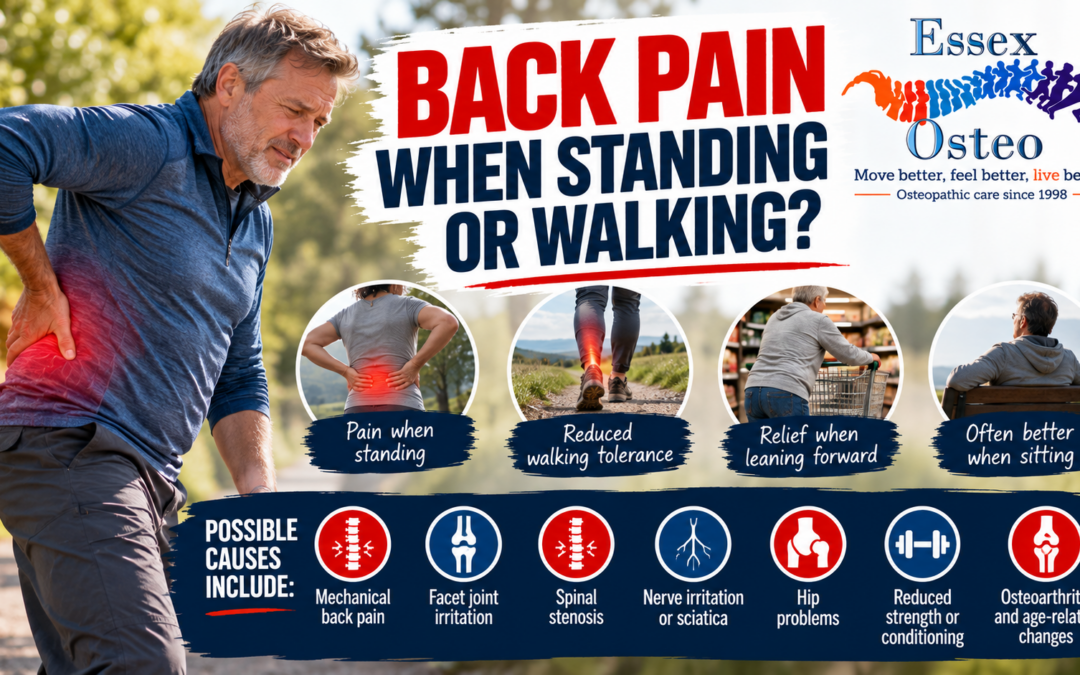
Back Pain When Standing or Walking – What Could Be Causing It?
Why Your Lower Back May Hurt When You’re on Your Feet
Does your lower back start aching when you stand for too long?
Perhaps you’re comfortable when sitting, but after walking around the shops, standing at work or taking the dog for a walk, your back gradually becomes painful. You might even find yourself looking for somewhere to sit down or leaning forward over a shopping trolley for relief.
At Essex Osteo in Stanford-le-Hope, this is a common pattern we see in people with lower back pain.
There isn’t one single explanation. Back pain while standing or walking can be associated with muscles and joints, reduced physical capacity, osteoarthritis, spinal stenosis, nerve irritation and several other conditions.
The pattern of your symptoms can provide useful clues.
Why Does My Back Hurt When I Stand for Too Long?
Standing requires continuous low-level muscular activity.
Your back, abdominal, hip and leg muscles all work together to keep you upright. If you’re not accustomed to prolonged standing—or your back is already sensitive—symptoms may gradually develop.
Possible contributing factors include:
- Reduced strength or conditioning
- Recent back pain
- Increased standing or walking
- Joint irritation
- Osteoarthritis
- Lumbar spinal stenosis
- Nerve irritation
- Hip problems
- Changes in your usual activity
- Fatigue
This doesn’t automatically mean your spine is damaged.
Sometimes you’ve simply exceeded your body’s current capacity for that activity.
Why Does My Back Hurt Standing but Feel Better Sitting?
This is a particularly useful symptom pattern.
Some people can sit relatively comfortably but develop increasing lower-back, buttock or leg symptoms while standing and walking.
Sitting may relieve symptoms simply because it changes the load and position of the spine.
However, in older adults, one condition we may also consider is lumbar spinal stenosis.
Lumbar Spinal Stenosis
Spinal stenosis describes narrowing within areas of the spinal canal or the openings through which spinal nerves travel.
It becomes increasingly common as we age.
Changes may include:
- Disc degeneration
- Disc bulging
- Facet joint enlargement
- Thickening of spinal ligaments
- Osteophytes
Importantly, having spinal stenosis on an MRI doesn’t automatically mean it is causing symptoms.
As with many spinal findings, the scan needs to fit the person’s history and clinical examination.
What Does Spinal Stenosis Feel Like?
Symptomatic lumbar spinal stenosis can produce:
- Lower back discomfort
- Buttock pain
- Aching in one or both legs
- Heaviness in the legs
- Tingling
- Numbness
- Reduced walking tolerance
- Symptoms when standing
- Relief when sitting or bending forwards
Symptoms affecting the legs during standing or walking are often described as neurogenic claudication.
A classic example is someone who can only walk a certain distance before symptoms appear but can walk further when leaning forward over a shopping trolley.
This is sometimes called the shopping trolley sign.
Why Does Leaning Forward Help My Back Pain?
For some people with spinal stenosis, bending forwards can increase the available space around the spinal nerves and reduce symptoms.
They may therefore find it easier to:
- Sit
- Cycle
- Lean over a shopping trolley
- Walk slightly bent forward
than to stand upright or walk for prolonged periods.
However, this pattern isn’t enough by itself to diagnose spinal stenosis.
Other conditions can produce similar symptoms.
Could It Just Be Mechanical Back Pain?
Yes.
Not everyone whose back hurts while standing has spinal stenosis.
A much more straightforward explanation may be mechanical or non-specific lower back pain.
Symptoms might be influenced by:
- How long you’ve been standing
- Recent physical activity
- Work demands
- Reduced fitness
- Muscle fatigue
- Joint sensitivity
- Previous back-pain episodes
Mechanical back pain frequently changes according to position and activity.
That doesn’t mean your vertebrae have moved out of place.
Could Facet Joints Cause Pain When Standing?
The facet joints are small joints at the back of your spine.
Like other joints, they can become sensitive or develop age-related changes.
Some people with facet-related pain report symptoms that are worse with:
- Prolonged standing
- Walking
- Extending backwards
- Rotating
- Getting up after sitting
Pain may remain predominantly in the lower back or sometimes spread into the buttock or upper thigh.
However, there isn’t a single examination test that can definitively prove a facet joint is the source of pain.
Diagnosis is therefore based on the overall clinical picture.
What About Arthritis in My Back?
Osteoarthritis and age-related spinal changes are extremely common.
An X-ray or MRI may use terms such as:
- Spondylosis
- Facet arthropathy
- Disc degeneration
- Osteophytes
- Degenerative changes
These words can sound worrying.
But they don’t necessarily mean your spine is “worn out”.
Many people have significant degenerative changes on imaging without significant pain.
Treatment should therefore focus on you and your symptoms—not simply your scan report.
Could Weak Muscles Be Causing It?
It is rarely as simple as saying:
“Your back hurts because your core is weak.”
However, strength and physical conditioning can influence how much activity you comfortably tolerate.
If you’ve become less active following previous back pain, illness or a sedentary period, prolonged standing and walking may become relatively demanding.
Gradually improving:
- Leg strength
- Hip strength
- Trunk strength
- Cardiovascular fitness
- Walking tolerance
may help improve overall physical capacity.
Why Does My Back Hurt When Walking Uphill or Downhill?
Walking gradients change the demands placed on your body.
Interestingly, some people with spinal stenosis tolerate walking uphill better than walking downhill because uphill walking naturally involves slightly more forward flexion.
Others may simply notice symptoms because hills increase physical demand.
Again, the pattern can provide useful information, but it shouldn’t be used in isolation to diagnose the problem.
What If the Pain Goes Into My Leg?
Back pain accompanied by leg symptoms needs a little more consideration.
You may experience:
- Buttock pain
- Thigh pain
- Calf pain
- Pins and needles
- Numbness
- Weakness
Possible causes include irritation of a spinal nerve, sciatica or spinal stenosis.
But not all leg pain comes from the spine.
Hip problems and vascular conditions can sometimes produce similar symptoms.
A clinical assessment can help determine which is more likely.
Neurogenic Claudication vs Vascular Claudication
This distinction is particularly important.
Neurogenic claudication is usually associated with irritation or compression of spinal nerves, commonly from lumbar spinal stenosis.
Symptoms are often influenced by spinal position.
People may feel better sitting or bending forwards.
Vascular claudication, on the other hand, results from reduced blood supply to the leg muscles, usually due to peripheral arterial disease.
Symptoms are often more consistently related to exercise distance and may improve simply by stopping—even while remaining standing.
Other clues to vascular disease can include:
- Cold feet
- Reduced pulses
- Changes in skin colour
- Poor wound healing
- Cardiovascular risk factors
Suspected vascular claudication requires appropriate medical assessment.
Could My Hip Be Causing the Pain?
Yes.
Hip problems can sometimes be mistaken for back problems.
Hip osteoarthritis, for example, can produce pain around the:
- Groin
- Front of the thigh
- Buttock
- Outer hip
- Occasionally knee
Walking tolerance may decrease and putting on shoes and socks can become difficult.
This is why a good back assessment should also consider the hips and lower limbs.
Should I Stop Walking If Walking Hurts My Back?
Usually, completely avoiding walking isn’t the long-term answer.
If walking aggravates your symptoms, you may temporarily need to adjust:
- Distance
- Speed
- Terrain
- Frequency
- Rest periods
You can then gradually rebuild your tolerance.
For example, if symptoms consistently appear after 20 minutes, starting with several shorter walks may be more manageable than repeatedly pushing through severe symptoms.
The goal is usually progressive exposure, not permanent avoidance.
What Exercises Can Help?
There isn’t one exercise programme suitable for everyone with standing or walking-related back pain.
Depending on the cause, rehabilitation might include:
Walking programmes
Gradually increasing distance or duration.
Strengthening
Exercises for the legs, hips and trunk can help improve physical capacity.
Cardiovascular exercise
Cycling may be particularly comfortable for some people with spinal stenosis because of the slightly flexed position.
Mobility exercises
Appropriate movement exercises may help maintain comfortable spinal and hip movement.
Functional exercises
Squatting, stepping and carrying exercises can help prepare you for everyday activities.
The programme should reflect your diagnosis, symptoms and goals.
Should I Push Through the Pain?
Not necessarily.
Some discomfort during rehabilitation isn’t automatically harmful, but repeatedly pushing into severe or progressively worsening symptoms isn’t always helpful either.
Exercise should be appropriately graded.
The aim is to gradually increase what you can comfortably do.
Do I Need an MRI?
Most people with straightforward mechanical back pain don’t need an MRI.
Imaging may become more relevant if there are:
- Significant neurological symptoms
- Progressive weakness
- Persistent symptoms despite appropriate management
- Suspected spinal stenosis where imaging would influence treatment
- Features suggesting serious pathology
- Consideration of injections or surgery
An MRI should ideally answer a specific clinical question rather than simply be ordered because somebody has back pain.
When Should I Be Concerned?
Most back pain during standing or walking isn’t caused by serious disease.
However, seek urgent medical attention if you develop:
🚩 New bladder or bowel dysfunction
🚩 Numbness around the genitals, anus or inner thighs
🚩 Significant or progressive leg weakness
🚩 Severe symptoms following major trauma
Medical assessment may also be appropriate for unexplained weight loss, fever, significant systemic illness, a history of cancer or other concerning symptoms.
And remember: calf or leg pain when walking isn’t always coming from your back. Possible vascular symptoms should be medically assessed.
Can Osteopathy Help Back Pain When Standing or Walking?
For appropriate musculoskeletal conditions, osteopathic care may form part of your management.
At Essex Osteo in Stanford-le-Hope, assessment may include your:
- Lower back
- Hips
- Lower limbs
- Movement
- Strength
- Neurological function where appropriate
- Walking tolerance
- Medical history
Treatment may include:
- Joint mobilisation
- Manipulation where appropriate
- Soft tissue techniques
- Exercise and rehabilitation
- Strengthening
- Advice about activity
- Walking progression
- Self-management strategies
Importantly, if your symptoms suggest that osteopathic treatment isn’t appropriate—or that further medical investigation is required—we can advise you accordingly.
Why Choose Essex Osteo?
At Essex Osteo, we’ve been providing osteopathic care in Stanford-le-Hope since 1998, helping people from Stanford-le-Hope, Corringham, Thurrock, Grays, Basildon and surrounding parts of Essex.
Our approach is based on more than simply treating the painful area.
We aim to understand:
Why are you struggling to stand or walk?
What is limiting you?
What can we realistically change?
How can we help you become more active and independent?
The objective isn’t endless treatment.
It’s helping you move better, understand your condition and confidently manage your health over the longer term.
Frequently Asked Questions
Why does my back hurt after standing for 10 minutes?
There are several possibilities, ranging from mechanical back pain and reduced physical capacity to facet joint sensitivity or spinal stenosis. The pattern of your symptoms and examination findings can help distinguish between them.
Why can I walk further when pushing a shopping trolley?
If bending forward significantly improves leg or back symptoms, lumbar spinal stenosis with neurogenic claudication is one possible explanation. However, this needs to be considered alongside other clinical findings.
Why does my back hurt walking but not cycling?
Cycling places the spine in a different position and may be better tolerated by some people, particularly those with lumbar spinal stenosis.
Does back pain when standing mean arthritis?
No. Arthritis is only one possibility, and degenerative changes are common in people without pain.
Should I keep walking with spinal stenosis?
Remaining physically active is generally important, but the type and amount of exercise may need adjusting according to your symptoms and health. An individual assessment can help establish an appropriate programme.
Can osteopathy cure spinal stenosis?
Osteopathy cannot reverse structural narrowing of the spinal canal. Conservative management may, however, help some people manage symptoms, maintain mobility and improve physical function. Significant or progressive neurological symptoms require appropriate medical assessment.
Struggling to Stand or Walk Because of Back Pain?
If your lower back starts aching every time you stand, your walking distance is getting shorter, or you’re increasingly looking for somewhere to sit down, it may be worth finding out why.
📅 Book a Back Pain Assessment
At Essex Osteo in Stanford-le-Hope, we’ll assess your symptoms, movement and neurological function where appropriate and consider whether your problem appears mechanical or whether further investigation or referral may be required.
👉 Click “Book Now” to arrange your Back Pain Assessment.
📍 Essex Osteo – Stanford-le-Hope, Essex
Serving Stanford-le-Hope, Corringham, Thurrock, Grays, Basildon and surrounding areas.
Providing osteopathic care since 1998.
Move better. Feel better. Live better.
SEO setup
SEO title:
Back Pain When Standing or Walking: Causes & Treatment | Essex Osteo
Meta description:
Back pain when standing or walking? Learn about mechanical back pain, spinal stenosis, arthritis and other possible causes. Essex Osteo, Stanford-le-Hope.
Suggested URL:
/back-pain-when-standing-or-walking/
Primary keyword: back pain when standing or walking