
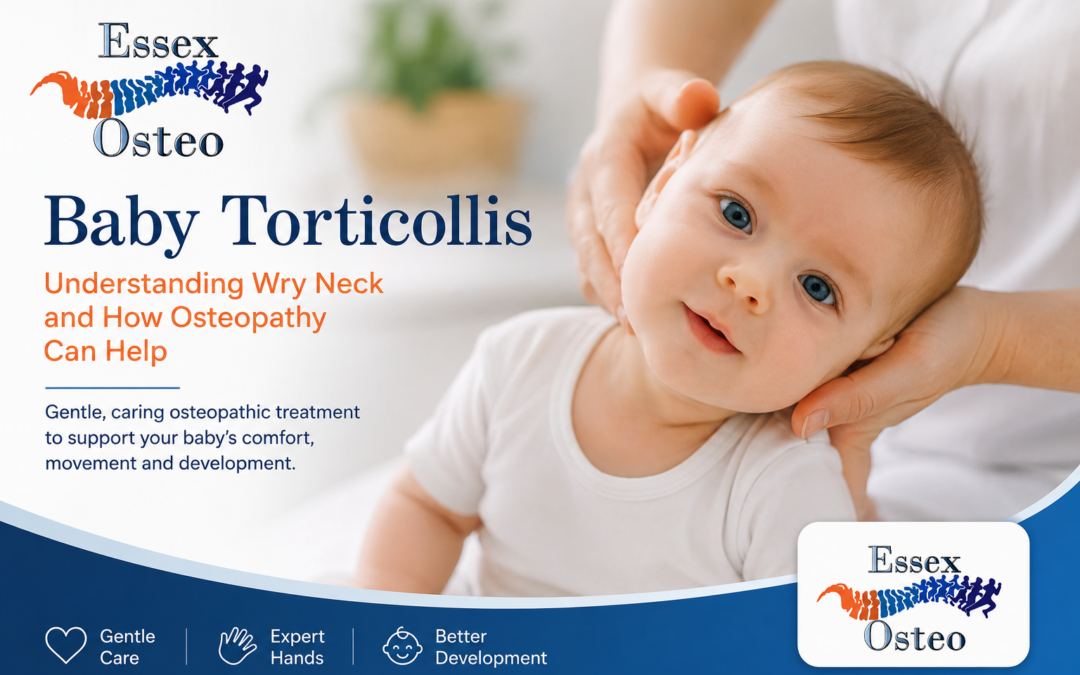
Does your baby always seem to look to one side? Have you noticed a head tilt or difficulty turning their head? If your baby was born following a forceps or ventouse delivery, you’re not alone in wondering whether these things could be connected.
At Essex Osteo in Stanford-le-Hope, we regularly assess babies with torticollis (wry neck), head-turning preferences and feeding or positioning difficulties. Our approach is always gentle, individualised and focused on supporting your baby’s comfort, movement and development.
What Is Baby Torticollis?
Baby torticollis, often called congenital muscular torticollis, occurs when one of the large neck muscles (the sternocleidomastoid muscle) becomes shortened or tight. This can cause your baby’s head to tilt to one side while their chin points towards the opposite shoulder.
Some babies develop torticollis before birth due to their position in the womb, while others may develop it following a more difficult or assisted delivery.
Early assessment is important because babies who consistently prefer one side may also be more likely to develop a flattened area of the head (positional plagiocephaly) if the preference is not addressed.
What Causes Torticollis in Babies?
There isn’t always a single cause, but factors that may contribute include:
- Limited space in the womb
- Breech presentation
- Multiple pregnancy (twins or triplets)
- A prolonged labour
- Forceps-assisted delivery
- Ventouse (vacuum-assisted) delivery
- Birth involving greater mechanical forces on the neck and shoulders
- Tightness within the neck muscles
Many babies with torticollis have no underlying medical problem and respond well to early management.
Is Torticollis More Common After Forceps Delivery?
An assisted delivery does not automatically mean your baby will develop torticollis. However, babies born using forceps or ventouse may experience additional mechanical forces around the head, neck and shoulders during birth, and some may develop muscle tightness or a preference for looking to one side.
If you’ve noticed that your baby:
- Always looks in one direction
- Struggles to turn towards one side
- Tilts their head
- Has difficulty feeding from one breast
- Prefers lying on one side
- Is developing a flat area on one side of their head
it is sensible to have them assessed by an appropriately trained healthcare professional.
Signs Your Baby May Have Torticollis
Every baby is different, but common signs include:
- A head tilt to one side
- Difficulty turning the head equally in both directions
- A preference for looking over one shoulder
- Flattening on one side of the back of the head (plagiocephaly)
- Difficulty latching on one breast but not the other
- Becoming unsettled during tummy time
- Preferring to sleep with their head turned one way
- Uneven shoulder positioning
Many parents first notice these signs within the first few weeks of life.
Why Early Assessment Matters
The earlier torticollis is recognised, the easier it is to encourage balanced movement and positioning while your baby is still developing.
Persistent head preference can influence:
- Head shape
- Neck movement
- Rolling
- Sitting balance
- Crawling symmetry
- Visual tracking
Most babies respond well to simple positioning advice and gentle exercises when started early.
How Can Osteopathy Help Babies With Torticollis?
Following a detailed medical history and assessment, an osteopath trained in paediatric care will examine your baby’s:
- Neck movement
- Head position
- Muscle tension
- Body symmetry
- Feeding positions
- General movement patterns
- Developmental milestones
Treatment, where appropriate, uses extremely gentle manual techniques designed for babies. Parents are often surprised by how subtle these techniques are.
Treatment may be combined with practical advice on:
- Feeding positions
- Carrying techniques
- Tummy time
- Positioning during play
- Sleeping position (always following safe sleep guidance)
- Encouraging your baby to look towards both sides
Every baby is different, so management is tailored to your child’s individual needs.
What Does the Research Say?
Current evidence suggests that early intervention, including stretching, positioning advice and parent education, is important in the management of congenital muscular torticollis. Osteopathic treatment may be used alongside these approaches as part of a multidisciplinary management plan where appropriate.
Your osteopath will always refer to your GP, paediatrician or another healthcare professional if further investigation or specialist management is indicated.
When Should You Seek Medical Advice?
You should seek medical assessment if:
- Your baby’s head tilt is worsening
- They appear to be in significant pain
- They have weakness or reduced movement in an arm or leg
- You notice abnormal eye movements
- There are concerns about their general development
- The head preference does not improve over time
- You have any concerns about your baby’s health or wellbeing
Not every head tilt is caused by muscular torticollis, so assessment is important.
Frequently Asked Questions
Can forceps delivery cause torticollis?
Forceps delivery does not necessarily cause torticollis, but some babies born following assisted delivery may develop tightness in the neck muscles or a preference for turning their head to one side. Several factors before, during and after birth can contribute.
At what age should my baby be assessed?
If you notice a persistent head tilt, difficulty turning the head equally, or a strong preference for looking to one side during the first few weeks or months, it’s sensible to seek assessment promptly. Earlier management is generally associated with better outcomes.
Can osteopathy help babies after a forceps or ventouse delivery?
Some parents choose osteopathic assessment following an assisted birth if they notice restricted neck movement, feeding difficulties related to head turning, or a positional preference. Treatment, where appropriate, uses very gentle techniques alongside advice on positioning and movement.
Is osteopathic treatment safe for babies?
When provided by an osteopath with appropriate paediatric training and experience, treatment is adapted specifically for babies using extremely gentle techniques. A full medical history and assessment are carried out before any treatment is considered.
Will my baby need exercises?
Many babies benefit from simple positioning strategies and gentle stretching or movement activities that parents can carry out at home. Your osteopath will explain these clearly and tailor them to your baby’s needs.
Can torticollis affect breastfeeding?
It can. Some babies find it easier to feed from one breast because turning towards the opposite side is uncomfortable or restricted. Improving neck movement and adjusting feeding positions may help.
Can torticollis cause a flat head?
Yes. Babies who consistently rest with their head turned to one side may develop positional plagiocephaly, where one area of the back or side of the head becomes flattened. Early recognition and regular repositioning can often help reduce this risk.
How many osteopathy appointments will my baby need?
This varies depending on your baby’s age, the severity of the restriction and how they respond. Some babies improve quickly with advice and gentle treatment, while others may require a short course of care alongside home positioning exercises.
Can torticollis improve without treatment?
Some mild cases improve naturally as babies grow and become more active. However, assessment is still worthwhile to ensure there is no underlying condition, to provide parents with practical advice and to reduce the likelihood of persistent movement restrictions or head shape changes.
Do I need a GP referral?
No. Most parents can book directly with an osteopath. However, if your osteopath feels further medical assessment or imaging is appropriate, they will advise you or refer you to your GP or paediatric team.
Baby Osteopathy in Stanford-le-Hope, Essex
At Essex Osteo, we provide gentle osteopathic assessments for babies with torticollis, head-turning preferences, positional plagiocephaly and musculoskeletal concerns following pregnancy and birth. Every assessment is tailored to your baby’s individual needs, with treatment and advice designed to support comfortable movement, healthy development and give parents confidence.
If you’re concerned about your baby’s neck movement or head position, we’re happy to discuss whether an assessment may be appropriate.