
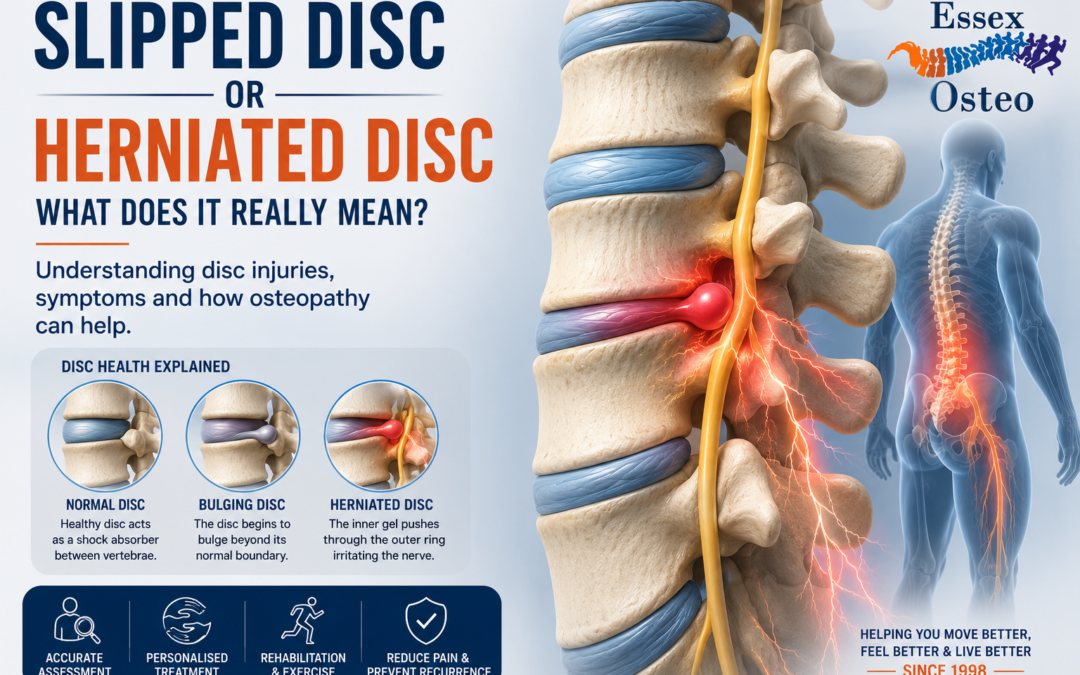
Slipped Disc or Herniated Disc – What Does It Mean?
Understanding Disc Injuries, Symptoms and Treatment at Essex Osteo, Stanford-le-Hope
One of the most common concerns we hear at Essex Osteo is, “I’ve been told I have a slipped disc.” The phrase can sound alarming and often leads people to believe their spine has been seriously damaged.
The good news is that discs do not actually “slip”, and most people with a herniated disc recover well without surgery. In many cases, symptoms improve with the right combination of education, movement, rehabilitation and evidence-based treatment.
In this guide, we’ll explain what a slipped disc really is, why it happens, the symptoms to look out for and how osteopathy may help your recovery.
What Is a Slipped Disc?
Despite the name, a slipped disc is a misleading term. The discs in your spine are firmly attached between the vertebrae and cannot simply slip out of place.
The correct medical terms include:
- Disc bulge
- Disc protrusion
- Disc herniation
- Prolapsed disc
Each spinal disc acts as a shock absorber, helping your spine move while distributing forces during everyday activities.
A disc has:
- A tough outer layer called the annulus fibrosus
- A softer, gel-like centre called the nucleus pulposus
A disc herniation occurs when part of the inner material pushes through a weakened area of the outer layer. Sometimes this causes no symptoms at all, while in other cases it may irritate a nearby nerve root.
How Common Are Disc Herniations?
Disc changes are extremely common and are often a normal part of ageing.
Research has shown that many people with no back pain whatsoever have disc bulges or herniations visible on MRI scans.
This means:
A disc bulge on a scan does not automatically explain your pain.
Your scan findings should always be interpreted alongside a detailed clinical assessment.
What Causes a Disc Herniation?
There is rarely one single cause.
Instead, several factors often combine over time, including:
Age-Related Changes
As we get older, discs naturally lose some water content and become less flexible.
Repetitive Loading
Frequent bending, lifting and twisting can place repeated stress on the disc.
Heavy Lifting
Poor lifting technique or lifting heavy objects repeatedly may contribute to disc irritation.
Prolonged Sitting
Long periods of sitting increase pressure within the lumbar discs, particularly if movement is limited.
Smoking
Smoking reduces blood supply to spinal tissues and may affect disc health.
Genetics
Some people appear genetically more prone to disc degeneration than others.
What Are the Symptoms?
Symptoms vary depending on whether the disc is irritating a nerve.
You may experience:
- Lower back pain
- Muscle spasm
- Difficulty bending forwards
- Pain when sitting
- Pain when coughing or sneezing
- Reduced movement
If a nerve root becomes irritated, symptoms may include:
- Sciatica
- Pain travelling into the buttock
- Pain down the leg
- Numbness
- Pins and needles
- Muscle weakness
- Altered reflexes
Some people have a large disc herniation with very little pain, while others have severe symptoms with only a small disc bulge.
Is Every Disc Bulge Painful?
No.
This is one of the biggest myths surrounding back pain.
MRI studies show that many healthy adults have:
- Disc bulges
- Disc degeneration
- Annular tears
without any pain at all.
Pain depends on how sensitive surrounding tissues and nerves have become—not simply what appears on a scan.
Do I Need an MRI?
Usually not.
Most patients can be accurately diagnosed through:
- A detailed history
- Physical examination
- Neurological assessment
- Movement testing
MRI is generally recommended when:
- Symptoms are severe
- Progressive weakness develops
- Surgery is being considered
- Symptoms fail to improve
- Serious pathology is suspected
Can Osteopathy Help?
Many patients benefit from an individual treatment programme aimed at improving movement and reducing pain.
Treatment may include:
Osteopathic Manual Therapy
Gentle hands-on treatment may help improve movement around irritated joints and muscles.
Soft Tissue Techniques
Reducing muscle tension can improve comfort and reduce protective muscle guarding.
Rehabilitation Exercises
Specific exercises help restore strength, improve spinal control and support recovery.
Dry Needling
Where appropriate, dry needling may help reduce muscle tension and improve movement.
Education
Understanding your diagnosis often reduces fear and encourages a confident return to normal activity.
Will I Need Surgery?
Most people do not.
Current evidence shows that many disc herniations gradually improve over time.
Surgery is usually considered only when:
- Severe weakness develops
- Cauda equina syndrome is suspected
- Pain remains severe despite appropriate treatment
- Symptoms significantly affect quality of life after conservative management
Can a Disc Herniation Heal?
Yes.
The body has an impressive ability to adapt.
Research suggests that many herniated discs reduce in size naturally over time through the body’s normal healing processes.
This is one reason why many patients recover without surgery.
When Should You Seek Emergency Medical Help?
Although uncommon, seek urgent medical attention immediately if you develop:
- Loss of bladder or bowel control
- Numbness around the saddle area
- Progressive leg weakness
- Severe pain after major trauma
- Fever with severe back pain
- Unexplained weight loss
These symptoms require urgent assessment.
How Can I Reduce My Risk?
You can help protect your spine by:
- Staying active
- Building core and hip strength
- Taking breaks from prolonged sitting
- Learning good lifting technique
- Maintaining a healthy weight
- Avoiding smoking
- Returning to exercise gradually after injury
Why Choose Essex Osteo?
Since 1998, Essex Osteo has helped patients across Stanford-le-Hope, Corringham, Thurrock, Basildon and Grays recover from back pain, sciatica and disc-related problems.
Ben Calvert-Painter is a Registered Osteopath, NHS MSK First Contact Practitioner, clinical educator and international lecturer with more than 25 years of clinical experience.
Every patient receives a comprehensive assessment, evidence-informed treatment and an individual rehabilitation programme tailored to their goals.
Continue Reading
A disc herniation is just one possible cause of low back pain and sciatica.
To understand spinal anatomy, mechanical back pain, sciatica, rehabilitation and prevention in more detail, read our Complete Guide to Low Back Pain—our cornerstone resource covering everything you need to know about back pain, diagnosis and recovery.
You may also find these articles helpful:
- What Causes Low Back Pain?
- Mechanical Low Back Pain Explained
- Sciatica: Causes, Symptoms and Treatment
- When Should You Have an MRI for Back Pain?
- How Osteopathy Helps Low Back Pain
Frequently Asked Questions
Is a slipped disc the same as a herniated disc?
Yes. “Slipped disc” is the common term, although “herniated disc” or “disc prolapse” is more accurate because the disc doesn’t actually slip out of place.
Can a slipped disc heal without surgery?
Yes. Most people recover with conservative treatment, including education, exercise, rehabilitation and, where appropriate, manual therapy.
Should I keep exercising?
For most people, yes. Staying active and gradually returning to normal movement is encouraged. Your exercise programme should be tailored to your symptoms.
Is walking good for a slipped disc?
Gentle walking is often beneficial as it helps maintain mobility, improve circulation and support recovery. Activity levels should be increased gradually based on your symptoms.
How do I know if my disc is pressing on a nerve?
Symptoms such as pain travelling below the knee, numbness, tingling or muscle weakness may suggest nerve irritation. A thorough clinical assessment can help determine the cause.
Book Your Assessment
If you’ve been told you have a slipped disc or you’re experiencing persistent back pain or sciatica, Essex Osteo can help.
Our comprehensive assessments identify the likely cause of your symptoms and provide a personalised treatment and rehabilitation plan to help you recover confidently.
Essex Osteo – Helping people move better, feel better and live better since 1998.