
Degenerative Disc Disease (DDD): Causes, Symptoms and Treatment
Understanding Age-Related Changes in the Spine
This naturally follows your articles on slipped discs and facet joint pain, while targeting another high-volume Google search term.
Degenerative Disc Disease (DDD): Causes, Symptoms and Treatment
Many people become concerned when an MRI reports “degenerative disc disease” (DDD). Despite the name, it isn’t actually a disease, nor does it necessarily mean your spine is damaged.
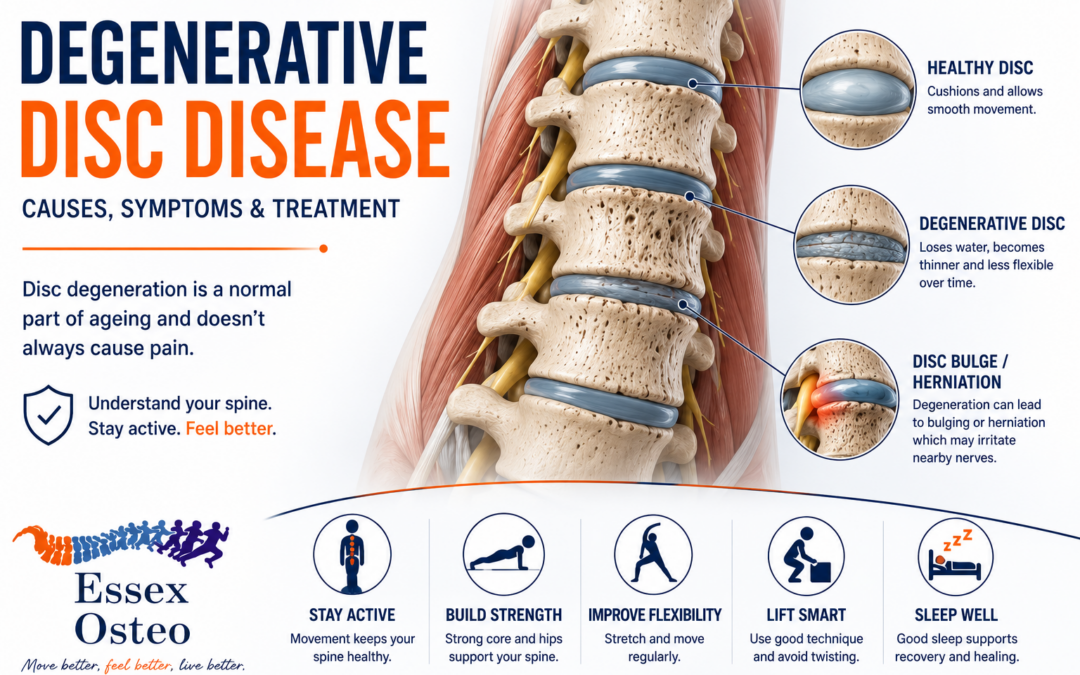
In fact, disc degeneration is a normal part of ageing. Many people have degenerative changes visible on MRI scans without experiencing any pain at all.
At Essex Osteo, one of the most common questions we hear is:
“Has my disc worn away?”
The answer is usually reassuring. While spinal discs naturally change over time, most people can successfully manage symptoms and remain active without surgery.
What Is Degenerative Disc Disease?
Your spine is made up of 24 movable vertebrae separated by intervertebral discs.
Each disc has two important components:
- Nucleus pulposus – the soft, gel-like centre that absorbs shock.
- Annulus fibrosus – the tough outer ring that provides stability.
Healthy discs act like cushions between the bones, allowing the spine to bend, twist and absorb everyday forces.
Over time, discs gradually:
- Lose water content
- Become less flexible
- Become thinner
- Develop small cracks within the outer fibres
These natural changes are referred to as disc degeneration.
Is Degenerative Disc Disease Normal?
Yes.
Research consistently shows that disc degeneration increases with age.
Many healthy adults with no back pain have MRI evidence of:
- Disc dehydration
- Reduced disc height
- Small disc bulges
- Annular tears
These findings are often part of normal ageing rather than the cause of pain.
This is why healthcare professionals always interpret MRI findings alongside your symptoms and physical examination.
What Causes Disc Degeneration?
Although ageing is the main factor, several things may influence how quickly discs change:
- Genetics
- Smoking
- Repetitive heavy lifting
- Previous spinal injuries
- Reduced physical activity
- Obesity
Most cases develop gradually over many years.
Common Symptoms
Many people experience no symptoms whatsoever.
When symptoms do occur, they may include:
- Persistent lower back ache
- Morning stiffness
- Pain after prolonged sitting
- Pain when bending forwards
- Reduced flexibility
- Muscle tightness
- Occasional pain into the buttocks
Pain often improves with walking and gentle movement.
Does Degenerative Disc Disease Cause Sciatica?
Not always.
Degenerated discs do not automatically compress nerves.
However, degeneration may contribute to:
- Disc bulges
- Herniated discs
- Narrowing around nerve roots
These changes may irritate nearby nerves and cause sciatica in some people.
How Is It Diagnosed?
Diagnosis begins with a detailed clinical assessment.
Your osteopath will assess:
- Movement
- Flexibility
- Muscle strength
- Neurological function
- Lifestyle factors
- Previous injuries
MRI is usually reserved for:
- Persistent symptoms
- Significant neurological changes
- Surgical planning
- Red flag symptoms
Remember:
People are treated—not MRI scans.
Can Degenerative Disc Disease Be Treated?
Yes.
Treatment focuses on improving how your spine functions rather than trying to reverse normal age-related changes.
Many people recover well with conservative care.
How Osteopathy Can Help
At Essex Osteo, treatment may include:
Hands-on osteopathic treatment
Helping improve spinal movement and reduce stiffness.
Soft tissue techniques
Reducing muscle tension and improving comfort.
Joint mobilisation
Improving spinal mobility.
Dry Needling
Where appropriate, dry needling may help reduce muscular pain and improve movement.
Rehabilitation
Exercises to improve:
- Core strength
- Hip strength
- Flexibility
- Endurance
- Confidence in movement
Education
Understanding your condition often reduces fear and helps people return to normal activities sooner.
Staying Active Is Key
One of the most effective treatments is regular movement.
Helpful activities include:
- Walking
- Swimming
- Cycling
- Pilates
- Strength training
- Yoga
Avoiding activity for long periods may increase stiffness and reduce confidence.
Can Surgery Cure Degenerative Disc Disease?
Most people do not need surgery.
Surgery is generally considered only when:
- Conservative treatment has failed
- Severe nerve compression is present
- Progressive neurological weakness develops
- Symptoms significantly affect quality of life
Fortunately, these situations are relatively uncommon.
When Should You Seek Professional Advice?
Arrange an assessment if:
- Pain persists for more than two weeks
- Symptoms repeatedly return
- Leg pain develops
- Walking becomes difficult
- Daily activities become limited
- You’re worried about your MRI findings
Early assessment can provide reassurance and help guide appropriate treatment.
Why Choose Essex Osteo?
Since 1998, Essex Osteo has been helping patients across Stanford-le-Hope, Corringham, Thurrock, Basildon and Grays manage spinal pain and maintain active lifestyles.
Ben Calvert-Painter is a Registered Osteopath, NHS MSK First Contact Practitioner, clinical educator and international lecturer with over 25 years of experience assessing and treating spinal conditions.
Our approach combines evidence-informed osteopathic care with personalised rehabilitation to help you move confidently and reduce the risk of future episodes.
Frequently Asked Questions
Is degenerative disc disease a disease?
No. It is a term used to describe normal age-related changes in the spinal discs.
Can discs heal?
While age-related changes cannot be completely reversed, symptoms often improve significantly with exercise, rehabilitation and conservative treatment.
Is walking good for degenerative disc disease?
Yes. Walking is one of the best low-impact activities for maintaining spinal mobility and improving overall function.
Should I stop exercising if my MRI shows degeneration?
No. Remaining active is usually one of the most effective ways to manage symptoms. Your exercise programme should be tailored to your individual needs.
Can osteopathy help degenerative disc disease?
Many people benefit from osteopathic treatment combined with education, manual therapy and rehabilitation to improve movement, reduce pain and support long-term spinal health.
References
- Brinjikji W, et al. Systematic Literature Review of Imaging Features of Spinal Degeneration in Asymptomatic Populations. American Journal of Neuroradiology. 2015.
- Hartvigsen J, et al. What low back pain is and why we need to pay attention. The Lancet. 2018.
- NICE Guideline NG59. Low back pain and sciatica in over 16s: assessment and management.
- World Health Organization. Low Back Pain Fact Sheet.