
Understanding Facet Joint Pain: Causes, Symptoms and Treatment at Essex Osteo, Stanford-le-Hope
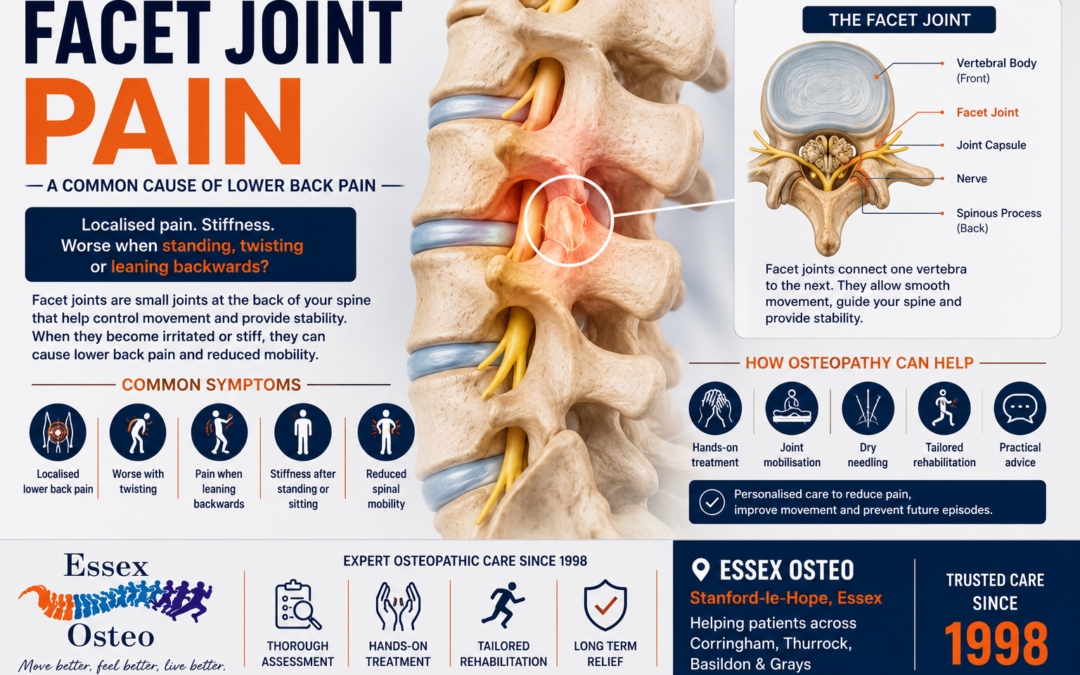
If you’ve been experiencing pain in your lower back that feels worse when standing, twisting or arching backwards, you may have heard the term facet joint pain. These small joints play an important role in allowing your spine to move smoothly, but like any joint in the body, they can become irritated or stiff.
At Essex Osteo in Stanford-le-Hope, facet joint pain is a common cause of back pain that we assess and treat. A thorough clinical examination is essential, as facet joint pain can share symptoms with muscle strains, disc problems and sacroiliac joint dysfunction.
In this guide, we’ll explain what facet joints are, why they become painful, how they are diagnosed and the treatment options available.
What Are Facet Joints?
Facet joints are small paired joints located at the back of each vertebra. They connect one vertebra to the next and help:
- Guide spinal movement
- Control bending and twisting
- Provide stability
- Prevent excessive movement
Like the knee or hip, facet joints are synovial joints, meaning they contain cartilage and lubricating fluid to allow smooth movement.
What Is Facet Joint Pain?
Facet joint pain occurs when one or more of these joints become irritated, inflamed or stiff.
It is one of the most common causes of mechanical low back pain and may develop suddenly after a movement or gradually over time.
Unlike sciatica, facet joint pain usually remains in the lower back or buttock and rarely travels below the knee.
What Causes Facet Joint Pain?
Several factors can contribute.
Repetitive Movements
Repeated bending, twisting or lifting can overload the facet joints.
Prolonged Standing
Standing for long periods places increased load on the posterior elements of the spine.
Arthritis
Age-related wear and tear (facet joint osteoarthritis) may contribute to stiffness and discomfort.
Sports
Golf, cricket, gymnastics, rowing and sports involving repeated spinal extension can increase stress on the facet joints.
Sudden Injury
A fall, awkward twist or lifting injury may irritate the joint capsule.
Poor Spinal Mobility
Reduced movement elsewhere in the spine can increase stress on neighbouring joints.
What Are the Symptoms?
Facet joint pain often causes:
- Pain on one or both sides of the lower back
- Localised aching
- Morning stiffness
- Pain when standing after sitting
- Pain when leaning backwards
- Pain during twisting movements
- Reduced spinal mobility
- Muscle tightness
Pain may spread into the buttock or upper thigh but rarely travels below the knee.
How Is Facet Joint Pain Different From Sciatica?
| Facet Joint Pain | Sciatica |
|---|---|
| Localised lower back pain | Pain travels below the knee |
| Worse bending backwards | Often worse bending forwards or sitting |
| Rarely causes numbness | May cause numbness or tingling |
| Usually no muscle weakness | Weakness may occur |
| Often stiffness | Often nerve pain |
Although these differences can provide clues, an assessment is important because symptoms can overlap.
How Is Facet Joint Pain Diagnosed?
There is no single test that confirms facet joint pain.
Diagnosis is based on:
- Detailed medical history
- Physical examination
- Movement assessment
- Palpation
- Functional testing
- Excluding other causes of back pain
In some specialist settings, diagnostic facet joint injections may be used when considering further treatment.
Do I Need an MRI?
Usually not.
Facet joint changes are common on MRI and CT scans, particularly as we age.
Just like disc bulges, facet arthritis seen on a scan does not necessarily cause pain.
Imaging is recommended only when clinically appropriate or when serious pathology needs to be excluded.
How Can Osteopathy Help?
Treatment depends on the findings of your assessment.
Your personalised treatment may include:
Osteopathic Manual Therapy
Gentle mobilisation techniques may help improve movement in stiff spinal joints.
Spinal Manipulation
Where appropriate, manipulation may help restore movement to restricted joints.
Not everyone requires manipulation, and treatment is always tailored to the individual.
Soft Tissue Treatment
Treating surrounding muscles can help reduce protective muscle tension.
Exercise Rehabilitation
Specific exercises improve:
- Spinal mobility
- Core strength
- Hip strength
- Movement control
- Functional movement
Dry Needling
Where appropriate, dry needling may help reduce muscle tension associated with facet joint irritation.
Lifestyle Advice
We may advise on:
- Sitting habits
- Standing posture
- Lifting technique
- Exercise modification
- Returning to work
- Returning to sport
Can Facet Joint Pain Improve?
Yes.
Most people improve well with conservative treatment.
Remaining active, completing a rehabilitation programme and addressing contributing factors often lead to excellent outcomes.
Persistent cases occasionally require additional medical management, such as facet joint injections, but these are not necessary for most people.
How Can You Prevent Facet Joint Pain?
You can reduce your risk by:
- Exercising regularly
- Strengthening your core muscles
- Improving hip mobility
- Avoiding prolonged sitting
- Taking regular movement breaks
- Using good lifting technique
- Maintaining a healthy body weight
When Should You Seek Medical Advice?
Arrange an assessment if:
- Pain lasts longer than two weeks
- Symptoms keep returning
- Your pain affects work or sleep
- Movement becomes increasingly restricted
- You’re unsure of the cause
Seek urgent medical attention if you develop:
- Loss of bladder or bowel control
- Saddle numbness
- Progressive leg weakness
- Fever
- Unexplained weight loss
- Severe pain after significant trauma
Why Choose Essex Osteo?
Since 1998, Essex Osteo has helped patients across Stanford-le-Hope, Corringham, Thurrock, Basildon and Grays recover from back pain and return to the activities they enjoy.
Ben Calvert-Painter is a Registered Osteopath, NHS MSK First Contact Practitioner, clinical educator and international lecturer with over 25 years of clinical experience in diagnosing and treating spinal conditions.
Every patient receives:
- A comprehensive assessment
- Individual diagnosis
- Evidence-informed treatment
- Personalised rehabilitation
- Practical self-management advice
Continue Reading
Facet joint pain is one of several causes of mechanical low back pain.
For a complete overview of spinal anatomy, disc injuries, sciatica, rehabilitation and prevention, visit our Complete Guide to Low Back Pain.
You may also find these articles useful:
- What Causes Low Back Pain?
- Mechanical Low Back Pain Explained
- Sciatica: Causes, Symptoms and Treatment
- Slipped Disc or Herniated Disc – What Does It Mean?
- Best Exercises for Low Back Pain
- How Osteopathy Helps Low Back Pain
Frequently Asked Questions
Can facet joint pain cause sciatica?
Facet joint pain usually remains in the lower back or buttock. It rarely causes pain below the knee. If you have pain, numbness or tingling travelling down your leg, another condition such as nerve root irritation may also be present.
Is walking good for facet joint pain?
For many people, gentle walking helps reduce stiffness and maintain movement. The amount should be increased gradually depending on your symptoms.
Can osteopathy help facet joint pain?
Many patients benefit from osteopathic treatment combined with rehabilitation exercises, education and practical advice to improve movement and reduce pain.
Is facet joint arthritis permanent?
Age-related changes in the facet joints are common and often do not cause symptoms. Even when arthritis is present, many people manage their symptoms successfully with exercise, manual therapy and lifestyle changes.
Book an Assessment
If you’re struggling with persistent lower back pain, stiffness or discomfort when standing or twisting, Essex Osteo can help.
Our comprehensive assessments identify the likely cause of your symptoms and provide a personalised treatment and rehabilitation plan to help you recover and move with confidence.
Essex Osteo – Trusted osteopathic care in Stanford-le-Hope, helping people move better, feel better and live better since 1998.
References
- National Institute for Health and Care Excellence (NICE). Low back pain and sciatica in over 16s: assessment and management (NG59).
- World Health Organization. Low Back Pain Fact Sheet.
- Cohen SP, et al. Lumbar facet joint pain: a comprehensive review. The Lancet Rheumatology.
- International Association for the Study of Pain (IASP). Low Back Pain Facts.