
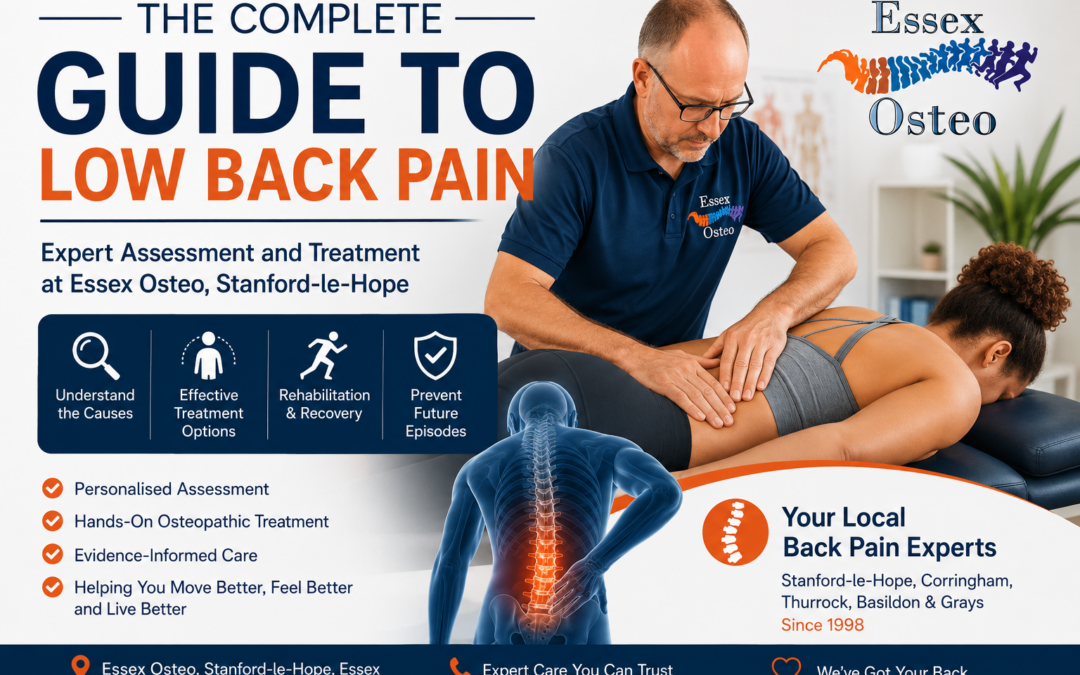
Evidence-Based Osteopathic Treatment for Back Pain at Essex Osteo, Stanford-le-Hope
Low back pain is one of the most common reasons people seek healthcare, affecting up to 8 in 10 people during their lifetime. Whether your pain started after lifting something heavy, spending long hours at a desk, gardening, exercising or developed gradually, it can have a significant impact on your work, sleep and quality of life.
One of the questions we are asked most frequently at Essex Osteo is:
“Can osteopathy help my back pain?”
For many people, the answer is yes.
Osteopathy is a recognised healthcare profession that focuses on diagnosing, treating and preventing musculoskeletal conditions. It combines hands-on treatment with exercise rehabilitation, education and practical advice to help reduce pain, restore movement and improve long-term spinal health.
What Is Osteopathy?
Osteopathy is a patient-centred approach to healthcare that looks beyond the site of pain.
Rather than focusing solely on the lower back, an osteopath considers how the entire body is functioning, including:
- Your posture
- Movement patterns
- Lifestyle
- Occupation
- Exercise habits
- Previous injuries
- General health
- Recovery goals
The aim is not only to reduce pain but also to identify the factors contributing to your symptoms and help prevent future episodes.
How Does Osteopathy Help Low Back Pain?
Back pain rarely has a single cause. Instead, it often results from a combination of factors affecting the muscles, joints, ligaments, discs and nervous system.
Osteopathy addresses these factors through a personalised treatment plan.
1. Comprehensive Assessment
Every appointment begins with a detailed assessment.
This includes:
- Discussing your symptoms
- Understanding how the pain started
- Reviewing your medical history
- Assessing work and sporting activities
- Identifying aggravating and easing factors
Your osteopath will then examine:
- Spinal movement
- Joint mobility
- Muscle strength
- Flexibility
- Nerve function
- Walking pattern
- Functional activities such as bending, lifting and sitting
This helps determine the likely cause of your symptoms and whether further investigations are needed.
2. Hands-On Treatment
Osteopathic treatment may include a combination of manual techniques designed to improve movement and reduce discomfort.
Depending on your assessment findings, treatment may involve:
Joint Mobilisation
Gentle rhythmic movements to improve spinal mobility.
Spinal Manipulation
For suitable patients, manipulation may help restore movement to stiff spinal joints.
Not everyone requires manipulation, and treatment is always tailored to the individual.
Soft Tissue Techniques
Massage and muscle release techniques may help reduce tension, improve circulation and improve comfort.
Stretching Techniques
Improving flexibility in the surrounding muscles can reduce stress on the lower back.
3. Exercise Rehabilitation
Research consistently shows that exercise is one of the most effective treatments for persistent low back pain.
At Essex Osteo, rehabilitation is never generic.
Your exercise programme is tailored to your assessment and may include:
- Core strengthening
- Hip strengthening
- Mobility exercises
- Walking programmes
- Balance training
- Functional strengthening
- Return-to-sport exercises
The aim is to improve confidence, movement and long-term resilience.
4. Education
One of the most powerful treatments we provide is helping patients understand their pain.
Many people worry they have caused permanent damage to their back.
In reality:
- Most back pain is mechanical.
- Most people recover well.
- Movement is usually safe.
- Staying active supports recovery.
- Scans do not always explain symptoms.
Understanding these facts often reduces fear and improves recovery.
5. Dry Needling
Where appropriate, dry needling may be incorporated into your treatment plan.
Dry needling may help:
- Reduce muscle tension
- Improve movement
- Ease muscle-related pain
- Support rehabilitation
It is always used alongside active rehabilitation rather than as a standalone treatment.
6. Lifestyle Advice
Recovery is influenced by much more than hands-on treatment.
Your osteopath may discuss:
- Sitting habits
- Workplace ergonomics
- Sleep position
- Exercise
- Lifting technique
- Stress management
- Weight management
- Returning to work
- Returning to sport
Does Osteopathy Work for Low Back Pain?
Clinical guidelines recommend exercise, education and manual therapy as part of a comprehensive approach to managing low back pain when appropriate.
Research suggests that many people experience improvements in:
- Pain levels
- Mobility
- Confidence
- Daily function
- Quality of life
The best results are typically achieved when manual therapy is combined with rehabilitation and self-management.
Will I Need an MRI?
Not usually.
Most cases of low back pain can be diagnosed through a detailed history and physical examination.
Scans are generally recommended only when:
- Serious pathology is suspected.
- Progressive neurological symptoms develop.
- Surgery is being considered.
- Symptoms fail to improve with appropriate management.
Many people without pain have disc bulges or arthritic changes visible on MRI, so scans must always be interpreted alongside your clinical assessment.
What Conditions Can Osteopathy Help?
At Essex Osteo, we commonly assess and treat:
- Mechanical low back pain
- Sciatica
- Disc-related pain
- Facet joint pain
- Sacroiliac joint pain
- Muscle strains
- Sports injuries
- Pregnancy-related back pain
- Persistent low back pain
When Should You See an Osteopath?
Consider booking an assessment if:
- Your pain has lasted longer than two weeks.
- Symptoms keep returning.
- Back pain is affecting work or sleep.
- You have pain travelling into the leg.
- You’re struggling to return to exercise.
- You’re unsure what is causing your symptoms.
Seek urgent medical attention if you develop:
- Loss of bladder or bowel control
- Saddle numbness
- Progressive leg weakness
- Fever or unexplained weight loss
- Severe pain after significant trauma
Why Choose Essex Osteo?
Since 1998, Essex Osteo has helped patients across Stanford-le-Hope, Corringham, Thurrock, Basildon and Grays recover from back pain and return to the activities they enjoy.
Ben Calvert-Painter is a Registered Osteopath, NHS MSK First Contact Practitioner, clinical educator and international lecturer with more than 25 years of clinical experience.
Every patient receives:
- A comprehensive assessment
- Individual diagnosis
- Evidence-informed treatment
- Personalised rehabilitation programme
- Practical self-management advice
- Ongoing support to reduce the risk of recurrence
Our goal is simple:
Help you move better, feel better and live better.
Continue Reading
Osteopathy is one part of successfully managing low back pain.
To learn more about spinal anatomy, common causes of back pain, slipped discs, sciatica, rehabilitation and prevention, visit our Complete Guide to Low Back Pain.
You may also find these articles useful:
- What Causes Low Back Pain?
- Mechanical Low Back Pain Explained
- Sciatica: Causes, Symptoms and Treatment
- Slipped Disc or Herniated Disc – What Does It Mean?
- Best Exercises for Low Back Pain
Frequently Asked Questions
Can osteopathy help low back pain?
Yes. Many people with mechanical low back pain benefit from osteopathic treatment combined with exercise, education and rehabilitation tailored to their individual needs.
Will my back be manipulated?
Not necessarily. Manipulation is just one of many treatment techniques. Your osteopath will choose the most appropriate approach based on your assessment and preferences.
How many treatments will I need?
This depends on your symptoms, how long you’ve had the problem and your recovery goals. Many patients notice improvement within a few sessions, while persistent conditions may require a longer rehabilitation programme.
Is osteopathic treatment painful?
Most treatment is gentle and well tolerated. Some people experience mild soreness afterwards, similar to what you might feel after exercise, but this usually settles within 24–48 hours.
Do I need a referral?
No. You can book directly with Essex Osteo without a GP referral.
Book Your Assessment
If you’re experiencing low back pain, sciatica or ongoing stiffness, don’t let it stop you enjoying life.
At Essex Osteo, we provide expert osteopathic care, evidence-based rehabilitation and personalised treatment plans to help you recover, move confidently and reduce the risk of future back pain.
Essex Osteo – Trusted osteopathic care in Stanford-le-Hope since 1998.
References
- National Institute for Health and Care Excellence (NICE). Low back pain and sciatica in over 16s: assessment and management (NG59).
- World Health Organization. Low Back Pain Fact Sheet.
- Foster NE, et al. Prevention and treatment of low back pain: evidence, challenges and promising directions. The Lancet. 2018.
- Qaseem A, et al. Non-invasive treatments for acute, subacute and chronic low back pain. Annals of Internal Medicine. 2017.