
The next logical article in your Low Back Pain Topic Cluster is:
Spondylolisthesis: Causes, Symptoms and Treatment
Understanding Vertebral Slippage and How Osteopathy Can Help
Following Degenerative Disc Disease and Lumbar Spinal Stenosis, this is the next condition that commonly appears on MRI reports and is frequently searched by patients. It also links naturally with stenosis because degenerative spondylolisthesis is a common cause of spinal canal narrowing.
Spondylolisthesis: Causes, Symptoms and Treatment
Being told you have spondylolisthesis can sound alarming, especially if you’ve read that one of the bones in your spine has “slipped.” However, most cases are mild, stable and can be managed successfully without surgery.
At Essex Osteo in Stanford-le-Hope, we regularly assess and treat people with spondylolisthesis. Through a combination of hands-on treatment, rehabilitation and education, we help patients reduce pain, improve movement and return to the activities they enjoy.
What Is Spondylolisthesis?
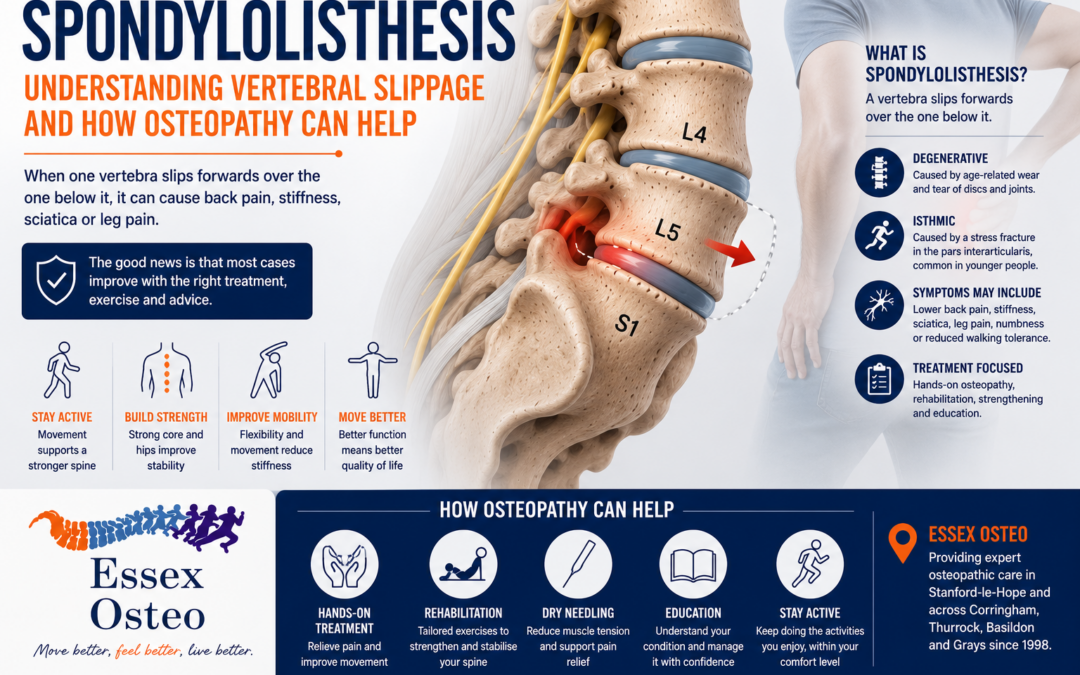
Spondylolisthesis occurs when one vertebra slips forwards relative to the vertebra below it.
It most commonly affects the L4/L5 or L5/S1 levels of the lumbar spine.
The amount of movement is graded from Grade I (up to 25%) through to Grade IV (75–100%), although most people have only a mild slip.
Types of Spondylolisthesis
Degenerative Spondylolisthesis
The most common form in adults.
It develops gradually due to age-related changes including:
- Degenerative disc disease
- Facet joint arthritis
- Ligament laxity
It is most common in adults over 50.
Isthmic Spondylolisthesis
Occurs when there is a defect or stress fracture (pars interarticularis) that allows the vertebra to slip.
It often develops during adolescence, particularly in sports involving repeated back extension such as gymnastics, cricket fast bowling and diving.
What Causes It?
Several factors can contribute, including:
- Age-related degeneration
- Repetitive spinal loading
- Previous stress fractures
- Genetics
- Facet joint arthritis
- Disc degeneration
Often there is no single cause.
Common Symptoms
Some people have no symptoms at all.
Others may experience:
- Persistent lower back pain
- Stiffness
- Pain after prolonged standing
- Buttock pain
- Leg pain or sciatica
- Tight hamstrings
- Reduced walking tolerance
- Difficulty walking uphill or downhill
If the slip narrows the spinal canal, symptoms of lumbar spinal stenosis may also develop.
How Is It Diagnosed?
Diagnosis begins with a detailed history and physical examination.
Your osteopath will assess:
- Lumbar movement
- Hip mobility
- Walking pattern
- Muscle strength
- Reflexes
- Sensation
- Balance
If necessary, imaging such as X-rays or MRI can confirm the diagnosis and assess the degree of slippage and any associated nerve compression.
Can Spondylolisthesis Be Treated Without Surgery?
Yes.
Most people improve with conservative treatment.
Treatment aims to:
- Reduce pain
- Improve spinal stability
- Restore confidence in movement
- Improve strength and flexibility
- Prevent recurring flare-ups
How Osteopathy Can Help
At Essex Osteo, treatment is tailored to your symptoms and goals and may include:
Hands-on osteopathic treatment
To improve mobility of the spine, pelvis and hips while avoiding excessive stress on the affected segment.
Soft tissue therapy
To reduce muscle tension and improve movement.
Rehabilitation
A personalised programme may include:
- Deep core strengthening
- Glute strengthening
- Hip stability exercises
- Balance training
- Functional movement retraining
Dry Needling
Where appropriate, dry needling may help relieve muscular pain and improve movement.
Education
Understanding the condition often reduces fear and helps people stay active with confidence.
Should You Keep Exercising?
In most cases, yes.
Appropriate exercise is one of the most effective ways to improve symptoms.
Activities that are often well tolerated include:
- Walking
- Swimming
- Cycling
- Pilates
- Strength training with appropriate guidance
Your exercise programme should always be individualised.
When Might Surgery Be Needed?
Surgery is only considered if:
- Symptoms remain severe despite conservative care
- Significant nerve compression develops
- Progressive weakness occurs
- Walking becomes severely restricted
- Bladder or bowel symptoms develop (medical emergency)
Fortunately, most people never require surgery.
When Should You Seek Urgent Medical Attention?
Seek immediate assessment if you develop:
- Loss of bladder or bowel control
- Numbness around the saddle area
- Rapidly worsening leg weakness
- Severe numbness affecting both legs
These symptoms could indicate cauda equina syndrome and require urgent medical care.
Living Well with Spondylolisthesis
Most people continue to lead active, healthy lives.
Key principles include:
- Stay active
- Build core strength
- Maintain hip mobility
- Avoid prolonged inactivity
- Manage flare-ups early
- Follow an individual rehabilitation programme
Why Choose Essex Osteo?
Since 1998, Essex Osteo has helped patients across Stanford-le-Hope, Corringham, Thurrock, Basildon and Grays manage spinal conditions using evidence-based osteopathic care.
Ben Calvert-Painter is a Registered Osteopath, NHS MSK First Contact Practitioner, clinical educator and international lecturer with more than 25 years of experience treating spinal disorders.
Our aim is to reduce pain, improve movement and help you remain active and independent.
Frequently Asked Questions
Is spondylolisthesis serious?
Usually not. Most cases are mild and respond well to conservative treatment.
Can exercise make it worse?
Appropriately prescribed exercise is generally beneficial and helps improve stability and function.
Can osteopathy help?
Many patients benefit from osteopathic treatment combined with tailored rehabilitation and education.
Will I need surgery?
Most people with spondylolisthesis do not require surgery.
Can the vertebra slip further?
Most degenerative Grade I slips remain stable, particularly when supported by good strength, mobility and regular exercise.
References
- NICE. Low Back Pain and Sciatica in Over 16s: Assessment and Management (NG59).
- North American Spine Society. Evidence-Based Clinical Guidelines for Degenerative Lumbar Spondylolisthesis.
- Hartvigsen J, et al. What low back pain is and why we need to pay attention. The Lancet. 2018.
Internal links
Link this article to:
- The Complete Guide to Low Back Pain
- Lumbar Spinal Stenosis
- Degenerative Disc Disease
- Facet Joint Pain
- Slipped Disc (Herniated Disc)
- Mechanical Low Back Pain
- Best Exercises for Low Back Pain
- How to Prevent Back Pain
This article targets search terms including spondylolisthesis, slipped vertebra, degenerative spondylolisthesis, L4/L5 slip, L5/S1 spondylolisthesis, osteopath for spondylolisthesis, and spondylolisthesis treatment in Stanford-le-Hope, further strengthening your low back pain content cluster.