
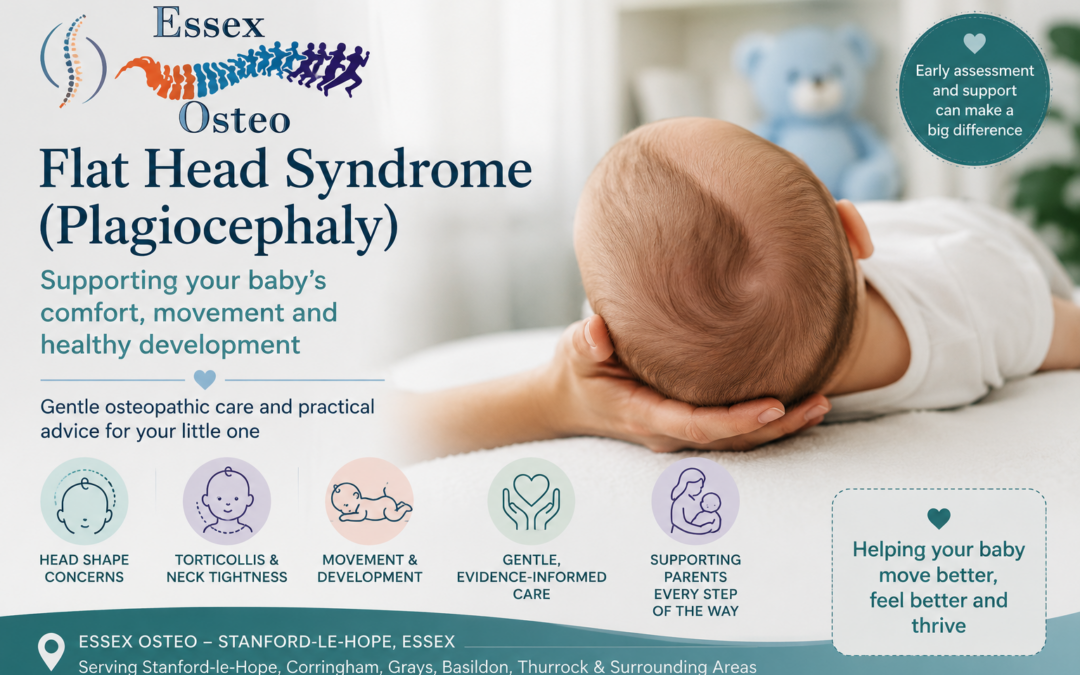
Flat Head Syndrome (Plagiocephaly): Causes, Treatment & How Osteopathy May Help Your Baby
A Parent’s Guide from Essex Osteo, Stanford-le-Hope
As a parent, it’s natural to notice every little detail about your baby’s development. One common concern is when the back or side of a baby’s head begins to look flatter than usual. This condition, known as plagiocephaly, or Flat Head Syndrome, affects many babies during their first year of life.
The good news is that in most cases, plagiocephaly is not harmful to brain development, and with early recognition and appropriate management, many babies show significant improvement over time.
At Essex Osteo in Stanford-le-Hope, we regularly assess babies with head shape concerns, neck stiffness and movement preferences. Working alongside your GP, health visitor, physiotherapist or paediatrician where appropriate, we provide gentle osteopathic assessment and advice tailored to your baby’s individual needs.
What Is Plagiocephaly?
Plagiocephaly is the medical term for a flattening of one area of a baby’s skull.
Because a newborn’s skull is soft and designed to allow rapid brain growth, prolonged pressure on one part of the head can gradually alter its shape.
You may notice:
- Flattening at the back or one side of the head
- One ear appearing slightly further forward
- Mild forehead prominence on one side
- A preference for looking in one direction
- Reduced neck movement
Many parents first notice these changes between 6 weeks and 4 months of age.
Why Does Flat Head Syndrome Happen?
There is rarely one single cause. More commonly, several factors contribute.
Position During Sleep
Following the successful “Back to Sleep” campaign to reduce Sudden Infant Death Syndrome (SIDS), babies are placed on their backs to sleep. This remains the safest sleeping position and should always be followed.
However, spending prolonged periods with pressure on the same area of the head can contribute to flattening.
Parents should always continue following safe sleep guidance.
A Preferred Head Position
Some babies naturally prefer turning their head to one side.
This may be due to:
- Mild muscular tightness
- Limited neck movement
- Intrauterine positioning
- Birth-related factors
Repeatedly resting on one side can gradually flatten that area.
Torticollis
Babies with congenital muscular torticollis often have tightness in one of the neck muscles (the sternocleidomastoid), making it difficult to turn the head equally in both directions.
This is one of the most common reasons plagiocephaly develops.
Birth Factors
Some babies experience increased pressure on the head during birth, particularly following:
- Long labour
- Assisted delivery (forceps or ventouse)
- Multiple births
- Breech positioning
- Larger babies
These factors do not always cause plagiocephaly but may contribute in some babies.
Premature Babies
Premature babies often spend longer lying on their backs in neonatal units, increasing the likelihood of positional flattening.
Is Plagiocephaly Dangerous?
In most cases, positional plagiocephaly is considered a cosmetic condition and does not affect brain development or intelligence.
However, it is important that babies with significant head shape changes are appropriately assessed to exclude less common conditions, such as craniosynostosis, where the bones of the skull fuse too early. This requires specialist medical assessment.
If your osteopath identifies any concerns outside the scope of osteopathic care, they will advise you to seek further medical assessment.
Signs Your Baby May Benefit From Assessment
You may wish to have your baby assessed if you notice:
- Flattening on one side of the head
- Difficulty turning the head
- A preference for looking one way
- Uneven head shape
- Reduced neck movement
- Difficulty feeding from one breast or side
- Persistent head tilt
- Concern from your health visitor
Early assessment often provides the greatest opportunity to improve movement and offer practical advice.
How Is Plagiocephaly Diagnosed?
Diagnosis is usually based on:
- Medical history
- Pregnancy history
- Birth history
- Observation of head shape
- Neck movement assessment
- Developmental milestones
- Muscle tension
- Feeding assessment
Referral may be recommended if further medical investigation is required.
How Can Osteopathy Help?
At Essex Osteo, treatment focuses on improving movement and reducing muscular tension, rather than directly reshaping the skull.
Following assessment, treatment may include gentle osteopathic techniques aimed at:
- Improving neck mobility
- Reducing muscular tightness
- Encouraging symmetrical movement
- Supporting comfortable positioning
- Providing advice on handling and positioning
- Supporting normal movement development
Treatment is always gentle, age-appropriate and adapted to your baby’s comfort.
Positioning Advice for Parents
Simple changes during the day may help reduce pressure on the flattened area.
These may include:
Encourage Tummy Time
Supervised tummy time helps strengthen:
- Neck muscles
- Shoulder muscles
- Upper back muscles
It also reduces the amount of time spent lying on the back while awake.
Alternate Feeding Positions
Changing feeding positions encourages babies to turn both directions equally.
Change Cot Position
Babies often look towards the room or doorway.
Alternating the direction your baby lies in the cot may encourage head turning to the opposite side.
Reduce Time in Car Seats
When safe and practical, avoid prolonged periods in:
- Car seats (outside travel)
- Bouncers
- Swings
Giving babies opportunities to move freely helps reduce continuous pressure on one part of the head.
Do Babies Need a Helmet?
Helmet therapy is not routinely recommended for most babies in the UK.
It may occasionally be considered in selected cases after specialist assessment, but many babies improve with:
- Growth
- Increased movement
- Repositioning strategies
- Management of associated neck tightness where present
Your healthcare team can advise whether specialist referral is appropriate.
What Happens During an Osteopathy Appointment?
Your baby’s appointment is relaxed and child-led.
We begin with a detailed discussion about:
- Pregnancy
- Birth
- Feeding
- Sleeping
- Development
- Medical history
We then carry out a gentle assessment of:
- Head shape
- Neck movement
- Muscle tension
- Overall movement
- Development
Parents remain with their baby throughout the appointment, with plenty of time for feeding, changing and cuddles.
Why Choose Essex Osteo?
At Essex Osteo, we’ve been helping families across Stanford-le-Hope, Corringham, Grays, Basildon and Thurrock since 1998.
We provide:
- Over 25 years of clinical experience
- Gentle, baby-friendly osteopathic care
- Individual assessment and treatment
- Evidence-informed practice
- Clear advice for parents
- Collaborative care with other healthcare professionals where appropriate
Our priority is supporting your baby’s comfort, movement and healthy development while giving you confidence and reassurance.
Frequently Asked Questions
Is plagiocephaly permanent?
Many babies improve significantly as they grow, particularly when recognised early and managed appropriately.
Can osteopathy reshape my baby’s skull?
No. Osteopathy does not reshape the skull. Treatment focuses on improving neck movement, reducing muscular tension and encouraging symmetrical movement, alongside advice on positioning and handling.
Is plagiocephaly painful?
Positional plagiocephaly itself is not usually painful, although some babies may also have associated neck tightness or torticollis.
When should I seek advice?
If you notice flattening of your baby’s head, a persistent head preference or reduced neck movement, it’s sensible to seek an assessment. Early advice can be helpful.
Is tummy time important?
Yes. Supervised tummy time supports strength, movement and development while reducing the time babies spend lying on the back when awake.
Do I need a GP referral?
No. You can book directly with Essex Osteo. If we feel your baby would benefit from further medical assessment, we’ll advise you accordingly.
Supporting Families Across South Essex
If you’re concerned about Flat Head Syndrome (Plagiocephaly), torticollis, or your baby’s head shape, Essex Osteo is here to help.
From our clinic in Stanford-le-Hope, we welcome families from Corringham, Grays, Basildon, Tilbury, South Ockendon, Canvey Island and across Thurrock.
Our gentle, evidence-informed approach focuses on supporting your baby’s comfort, movement and development while providing reassurance and practical advice for parents.
Book an appointment with Essex Osteo today and let us help your little one get off to the best possible start.