
Piriformis Syndrome: Causes, Symptoms and Treatment
Understanding Deep Buttock Pain, Sciatica-like Symptoms and How Osteopathy Can Help
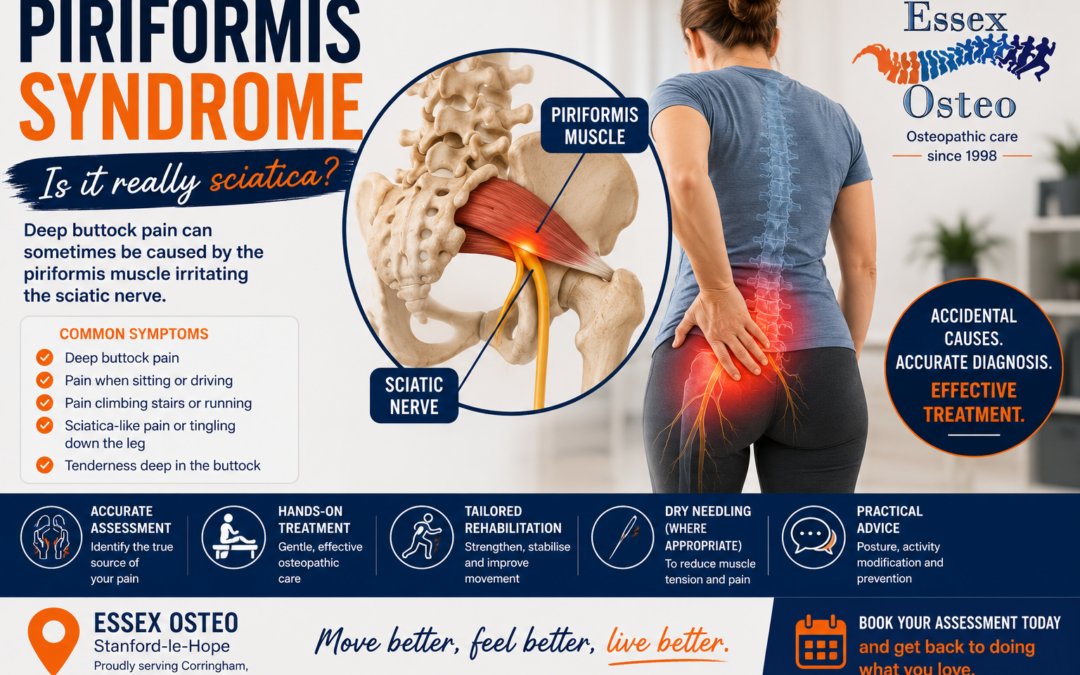
Have you been told you have piriformis syndrome, or are you experiencing deep buttock pain that travels down your leg? While many people assume these symptoms are caused by a slipped disc or trapped nerve in the lower back, the source of the problem can sometimes be a small muscle deep within the buttock called the piriformis.
Piriformis syndrome is one of the most talked-about causes of sciatica-like symptoms, but it is also one of the most misunderstood. In recent years, healthcare professionals have increasingly used the broader term Deep Gluteal Syndrome, recognising that several structures in the buttock—not just the piriformis muscle—can irritate the sciatic nerve.
At Essex Osteo in Stanford-le-Hope, we carry out detailed assessments to determine whether your symptoms are coming from your lower back, hip, sacroiliac (SI) joint or the deep gluteal region, ensuring you receive the most appropriate treatment.
What Is Piriformis Syndrome?
The piriformis is a small muscle located deep within the buttock. It runs from the sacrum (base of the spine) to the greater trochanter of the femur (thigh bone).
Its main roles are to:
- Rotate the hip outwards
- Help stabilise the hip during walking
- Support balance when standing on one leg
The sciatic nerve usually passes underneath the piriformis muscle, although anatomical variations exist where it passes through or above the muscle.
When the piriformis becomes tight, inflamed or overloaded, it may irritate the sciatic nerve, leading to buttock pain and symptoms that resemble sciatica.
Piriformis Syndrome or Deep Gluteal Syndrome?
Research has shown that not all sciatic nerve irritation in the buttock is caused by the piriformis muscle alone.
Other muscles and structures within the deep gluteal region may also compress or irritate the sciatic nerve. For this reason, many specialists now use the term Deep Gluteal Syndrome (DGS).
Although the term “piriformis syndrome” remains widely recognised by patients and healthcare professionals, it’s important to understand that several structures may contribute to similar symptoms.
What Causes Piriformis Syndrome?
Several factors may contribute:
Prolonged Sitting
Long periods sitting at work or driving can increase pressure on the deep gluteal muscles.
Running
Sudden increases in training, hills or poor running mechanics may overload the piriformis.
Cycling
Extended periods on a bicycle can irritate the muscle.
Hip Weakness
Weak gluteal muscles often place additional strain on the piriformis.
Trauma
A fall onto the buttock or sporting injury may irritate the muscle.
Altered Movement Patterns
Previous back, hip, knee or foot problems may change biomechanics and overload the piriformis.
Common Symptoms
People with piriformis syndrome often describe:
- Deep buttock pain
- Pain sitting for long periods
- Pain when driving
- Tenderness in the buttock
- Pain climbing stairs
- Pain after running
- Sciatica-like pain down the leg
- Tingling or numbness (less common)
Symptoms often worsen after prolonged sitting and improve with movement.
Piriformis Syndrome vs Sciatica
Many people confuse piriformis syndrome with lumbar sciatica.
| Piriformis Syndrome | Lumbar Sciatica |
|---|---|
| Deep buttock pain | Lower back with leg pain |
| Often no significant back pain | Back pain is common |
| Worse sitting | Often worse bending forwards or coughing |
| Tender buttock muscles | Lumbar spine tenderness |
| Hip movements may reproduce symptoms | Lumbar movements often reproduce symptoms |
| Neurological signs usually normal | May have altered reflexes, strength or sensation |
A thorough examination is essential because symptoms can overlap.
Piriformis Syndrome vs SI Joint Pain
SI joint pain can also mimic piriformis syndrome.
| Piriformis Syndrome | SI Joint Pain |
|---|---|
| Deep buttock muscle tenderness | Pain directly over the SI joint |
| Pain sitting | Pain turning in bed |
| Pain driving | Pain standing from sitting |
| Often aggravated by hip movement | Often aggravated by weight-bearing |
At Essex Osteo, we assess the lumbar spine, pelvis and hips to accurately identify the source of your symptoms.
How Is Piriformis Syndrome Diagnosed?
There is no single scan or test that confirms piriformis syndrome.
Diagnosis is based on:
- Detailed history
- Lumbar spine assessment
- Hip examination
- Neurological examination
- Functional movement assessment
- Palpation of the deep gluteal muscles
- Specific provocation tests
The main aim is to exclude other causes of buttock and leg pain.
Do I Need an MRI?
Usually not.
MRI may be appropriate if:
- Symptoms are severe
- Significant neurological changes develop
- A lumbar disc injury is suspected
- Symptoms fail to improve
Most cases can be diagnosed clinically.
How Can Osteopathy Help?
Treatment depends on the findings of your assessment.
Your personalised treatment may include:
Hands-on Osteopathic Treatment
Improving movement in the lumbar spine, pelvis and hips.
Soft Tissue Therapy
Reducing muscle tension in the piriformis and surrounding muscles.
Dry Needling
Where appropriate, dry needling may help reduce muscle tension and improve movement.
Rehabilitation
Your programme may include:
- Hip strengthening
- Glute strengthening
- Core exercises
- Balance training
- Functional movement retraining
- Running-specific rehabilitation where appropriate
Activity Advice
We may advise on:
- Sitting posture
- Driving breaks
- Return to running
- Exercise modification
- Workplace ergonomics
Should You Stretch the Piriformis?
Stretching can be helpful for some people, but it is not always the answer.
Many patients actually benefit more from:
- Improving hip strength
- Building gluteal endurance
- Increasing movement confidence
- Correcting training errors
Stretching should form part of an individual rehabilitation programme rather than being the only treatment.
Can Piriformis Syndrome Be Prevented?
You can reduce your risk by:
- Strengthening your gluteal muscles
- Gradually increasing exercise intensity
- Taking breaks from prolonged sitting
- Maintaining hip mobility
- Warming up before sport
- Managing running or cycling training loads
When Should You Seek Medical Advice?
Arrange an assessment if:
- Buttock pain lasts more than two weeks
- Symptoms repeatedly return
- Pain travels down your leg
- Sitting becomes difficult
- You’re unsure whether your symptoms are coming from your back or hip
Seek urgent medical attention if you develop:
- Loss of bladder or bowel control
- Saddle numbness
- Progressive leg weakness
These symptoms may indicate cauda equina syndrome and require immediate assessment.
Why Choose Essex Osteo?
Since 1998, Essex Osteo has helped patients across Stanford-le-Hope, Corringham, Thurrock, Basildon and Grays recover from back, hip and buttock pain.
Ben Calvert-Painter is a Registered Osteopath, NHS MSK First Contact Practitioner, clinical educator and international lecturer with over 25 years of experience assessing and treating complex musculoskeletal conditions.
Every patient receives:
- A comprehensive assessment
- Accurate diagnosis
- Evidence-informed treatment
- Personalised rehabilitation
- Practical advice to prevent recurrence
Our goal is to help you move better, feel better and return to the activities you enjoy.
Frequently Asked Questions
Can piriformis syndrome cause sciatica?
Yes. Irritation of the sciatic nerve in the deep gluteal region can produce symptoms similar to lumbar sciatica.
Is walking good for piriformis syndrome?
For many people, gentle walking is beneficial. The amount should be increased gradually depending on your symptoms.
Is massage helpful?
Soft tissue treatment may help reduce muscle tension, but it is usually most effective when combined with strengthening exercises and rehabilitation.
How long does recovery take?
Many people improve over several weeks with appropriate treatment, activity modification and rehabilitation, although recovery varies depending on the cause and severity of symptoms.
Can osteopathy help piriformis syndrome?
Yes. Osteopathic treatment combined with rehabilitation, education and exercise may help reduce pain, improve movement and address the underlying factors contributing to your symptoms.
Book an Assessment
If you’re struggling with persistent buttock pain, sciatica-like symptoms or discomfort when sitting, Essex Osteo can help.
Our comprehensive assessments identify the true source of your symptoms and provide a personalised treatment plan to help you recover and move with confidence.
Essex Osteo – Trusted osteopathic care in Stanford-le-Hope since 1998, helping you move better, feel better and live better.
References
- Martin HD, et al. Deep Gluteal Syndrome. Journal of Hip Preservation Surgery.
- Boyajian-O’Neill LA, et al. Diagnosis and Management of Piriformis Syndrome. American Family Physician.
- National Institute for Health and Care Excellence (NICE). Low Back Pain and Sciatica in Over 16s: Assessment and Management (NG59).
- International Society for Hip Arthroscopy (ISHA). Deep Gluteal Syndrome Consensus.
Internal links
Link this article to:
- The Complete Guide to Low Back Pain (pillar page)
- Sciatica: Causes, Symptoms and Treatment
- Sacroiliac (SI) Joint Pain
- Mechanical Low Back Pain Explained
- How Osteopathy Helps Low Back Pain
- Best Exercises for Low Back Pain
- Greater Trochanteric Pain Syndrome
- Hip Pain: Causes, Symptoms and Treatment (future article)
SEO optimisation
This article naturally targets high-value search terms including:
- Piriformis syndrome
- Deep gluteal syndrome
- Piriformis muscle pain
- Buttock pain
- Sciatica-like symptoms
- Pain when sitting
- Pain driving
- Trapped sciatic nerve
- Osteopath for piriformis syndrome
- Piriformis syndrome treatment Stanford-le-Hope
- Buttock pain Essex