
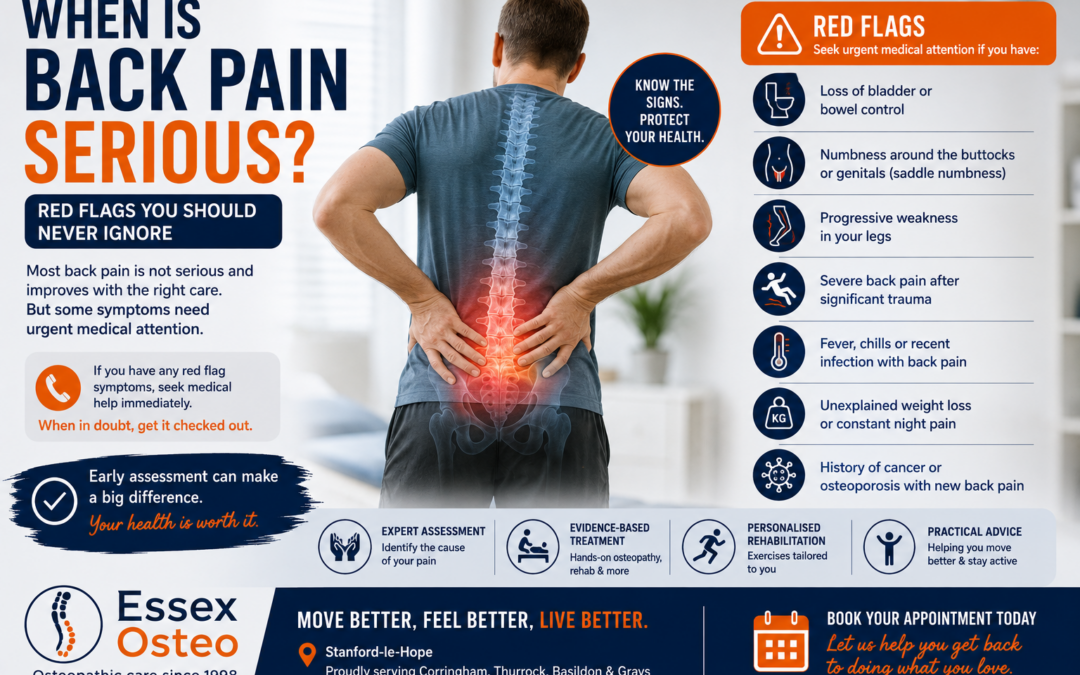
When Is Back Pain Serious? Red Flags You Should Never Ignore
When Should You See an Osteopath, GP or Go Straight to A&E?
Back pain affects millions of people every year and is one of the most common reasons for visiting an osteopath, physiotherapist or GP. The reassuring news is that around 90–95% of low back pain is mechanical, meaning it is not caused by a serious underlying condition and usually improves with the right advice, movement and treatment.
However, there are occasions when back pain can be a sign of a more serious medical problem. Recognising these red flags is essential, as early diagnosis and treatment can make a significant difference.
At Essex Osteo in Stanford-le-Hope, every patient receives a thorough assessment to identify whether their symptoms are mechanical or whether further medical investigation or urgent referral is required. As an NHS MSK First Contact Practitioner and Registered Osteopath, Ben Calvert-Painter is experienced in recognising serious spinal conditions and ensuring patients receive the most appropriate care.
The Good News – Most Back Pain Is Not Serious
Most episodes of back pain are caused by:
- Muscle strains
- Ligament sprains
- Joint irritation
- Disc injuries
- Facet joint pain
- Sacroiliac joint dysfunction
These conditions often improve with:
- Staying active
- Appropriate exercise
- Osteopathic treatment
- Education and reassurance
- Time
The aim of a clinical assessment is to identify these common problems while remaining alert to signs that suggest something more serious.
What Are Red Flags?
Red flags are symptoms or findings that may indicate a serious underlying condition requiring urgent medical assessment.
Although serious spinal conditions are uncommon, it is important not to ignore warning signs.
1. Cauda Equina Syndrome – A Medical Emergency
One of the most important conditions to recognise is cauda equina syndrome (CES).
This occurs when the bundle of nerves at the base of the spinal cord becomes compressed, usually by a large disc prolapse, but occasionally by other conditions such as tumours, infections or bleeding.
Seek emergency medical attention immediately if you experience:
🚩 Difficulty starting or controlling urination
🚩 Loss of bladder or bowel control
🚩 Numbness around the buttocks, genitals or inner thighs (known as saddle numbness)
🚩 Progressive weakness affecting one or both legs
🚩 Loss of sexual sensation or function
These symptoms require immediate assessment in an Emergency Department. Early surgery offers the best chance of preventing permanent nerve damage.
2. Suspected Spinal Fracture
A fracture should be considered if back pain develops after:
- A significant fall
- A road traffic collision
- Heavy trauma
- A sporting injury
Older adults and people with osteoporosis may sustain fractures after relatively minor injuries.
Warning signs include:
- Sudden severe back pain
- Pain directly over the spine
- Difficulty standing upright
- Pain that is much worse with movement
Medical assessment and imaging may be required.
3. Infection of the Spine
Although rare, spinal infections require urgent diagnosis and treatment.
Seek medical advice if back pain is accompanied by:
- Fever
- Chills
- Night sweats
- Feeling generally unwell
- Recent surgery
- Recent serious infection
- Intravenous drug use
- A weakened immune system
These symptoms should never be ignored.
4. Cancer Affecting the Spine
Back pain is rarely caused by cancer.
However, further investigation may be appropriate if you have:
- A previous history of cancer
- Unexplained weight loss
- Constant pain that is unrelated to movement
- Pain that is worse at night
- Persistent symptoms despite treatment
Having one of these features does not mean you have cancer, but they should prompt further medical assessment.
5. Inflammatory Back Pain
Unlike mechanical back pain, inflammatory conditions such as axial spondyloarthritis (including ankylosing spondylitis) often present differently.
Typical features include:
- Pain beginning before the age of 45
- Morning stiffness lasting longer than 30 minutes
- Pain improving with exercise
- Pain worsening with prolonged rest
- Waking during the second half of the night because of back pain
If these symptoms are present, referral to a rheumatologist may be appropriate.
6. Abdominal Aortic Aneurysm (AAA)
Occasionally, severe back pain originates from the abdomen rather than the spine.
An abdominal aortic aneurysm can present with:
- Sudden severe abdominal, back or flank pain
- A pulsating sensation in the abdomen
- Dizziness or collapse
- Fainting
- Low blood pressure
A ruptured AAA is a life-threatening emergency requiring immediate medical attention.
7. Kidney Problems
Not all back pain comes from the spine.
Kidney stones or kidney infections may cause pain in the flank or lower back.
Symptoms may include:
- Pain higher in the back (around the ribs)
- Pain that comes in waves (kidney stones)
- Painful urination
- Blood in the urine
- Fever
- Nausea or vomiting
These symptoms require medical assessment.
8. Osteoporotic Compression Fractures
People with osteoporosis are at increased risk of vertebral compression fractures.
Warning signs include:
- Sudden severe back pain
- Loss of height
- Increasing spinal curvature
- Pain following a minor lift or twist
Early diagnosis can help reduce complications and improve recovery.
When Is Back Pain Usually Mechanical?
Mechanical back pain is by far the most common type of back pain.
It typically:
✅ Changes with movement
✅ Improves with gentle activity
✅ Varies throughout the day
✅ Is affected by posture
✅ Improves over several weeks
Mechanical pain often responds well to conservative treatment, rehabilitation and self-management.
When Should You See an Osteopath?
Book an assessment if:
- Your back pain has lasted more than two weeks
- Symptoms keep returning
- Pain is affecting work or sleep
- You’re unsure of the cause
- You would like expert advice on treatment and rehabilitation
A comprehensive assessment can help identify the cause of your symptoms and guide the most appropriate treatment.
How Essex Osteo Can Help
At Essex Osteo, we don’t just treat pain—we aim to identify why it has developed.
Every assessment includes:
- A detailed medical history
- Screening for serious pathology (red flags)
- Neurological examination where appropriate
- Movement assessment
- Functional testing
- Individual diagnosis
- Personalised rehabilitation advice
Treatment may include:
- Hands-on osteopathic treatment
- Joint mobilisation or manipulation (where appropriate)
- Soft tissue therapy
- Dry needling
- Rehabilitation exercises
- Education and self-management advice
If your symptoms suggest a condition requiring medical investigation, we will advise or refer you appropriately.
Why Choose Essex Osteo?
Since 1998, Essex Osteo has helped patients across Stanford-le-Hope, Corringham, Thurrock, Basildon and Grays recover from back pain and return to the activities they enjoy.
Ben Calvert-Painter is a Registered Osteopath, NHS MSK First Contact Practitioner, clinical educator and international lecturer with over 25 years of experience assessing and managing spinal conditions.
Our approach combines evidence-based osteopathic care with rehabilitation and patient education, ensuring every patient receives an accurate assessment and the right advice.
Frequently Asked Questions
Is back pain usually serious?
No. Around 90–95% of back pain is mechanical and improves with conservative treatment, exercise and time.
When should I go to A&E with back pain?
Go to the Emergency Department immediately if you develop loss of bladder or bowel control, saddle numbness, progressive leg weakness, severe back pain after major trauma, or symptoms suggesting a ruptured abdominal aortic aneurysm.
Can an osteopath recognise serious back problems?
Yes. Registered osteopaths are trained to screen for red flags, identify when further investigations are needed and refer patients appropriately when serious pathology is suspected.
Is night pain always a red flag?
Not necessarily. Pain that prevents you from finding a comfortable position can occur with mechanical back pain. However, constant, unrelenting night pain that is not eased by changing position, particularly if associated with weight loss, fever or a history of cancer, should be assessed by a healthcare professional.
Should I have an MRI?
Most people with mechanical back pain do not need an MRI. Imaging is usually recommended when serious pathology is suspected, significant neurological symptoms are present, or symptoms persist despite appropriate treatment.
Book an Assessment
If you’re experiencing back pain and are unsure whether it’s something to worry about, Essex Osteo can help.
Our comprehensive assessments are designed to identify the cause of your symptoms, rule out serious conditions and provide an evidence-based treatment plan tailored to your needs.
Whether your pain is mechanical or requires further investigation, you’ll receive clear advice and the appropriate care pathway.
Essex Osteo – Trusted osteopathic care in Stanford-le-Hope since 1998, helping you move better, feel better and live better.
References
- National Institute for Health and Care Excellence (NICE). Low Back Pain and Sciatica in Over 16s: Assessment and Management (NG59).
- National Institute for Health and Care Excellence (NICE). Suspected Neurological Conditions (NG127).
- Faculty of Pain Medicine, Royal College of Anaesthetists. Red Flags in Back Pain.
- World Health Organization. Low Back Pain Fact Sheet.
- Hartvigsen J, et al. What Low Back Pain Is and Why We Need to Pay Attention. The Lancet. 2018.
- Greenhalgh S, et al. International Framework for Red Flags for Potential Serious Spinal Pathologies. Journal of Orthopaedic & Sports Physical Therapy.
Internal links to strengthen your topic cluster
This article should link to:
- The Complete Guide to Low Back Pain (pillar page)
- What Causes Low Back Pain?
- Mechanical Low Back Pain Explained
- Sciatica: Causes, Symptoms and Treatment
- Slipped Disc or Herniated Disc
- Lumbar Spinal Stenosis
- Facet Joint Pain
- Sacroiliac (SI) Joint Pain
- Piriformis Syndrome
- How to Prevent Back Pain