
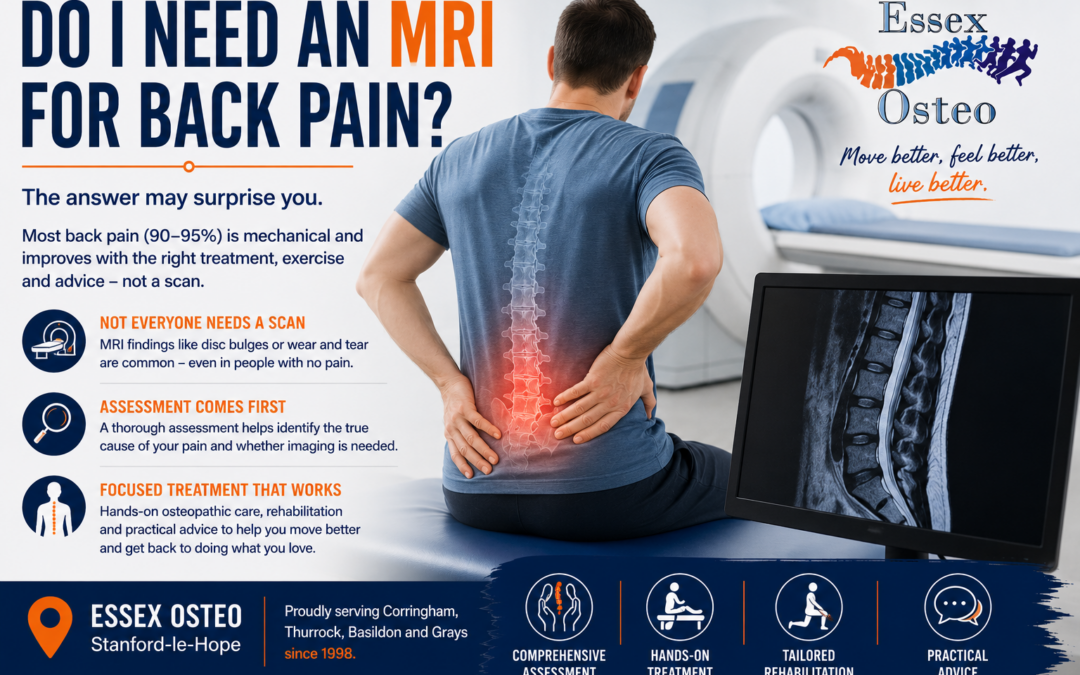
Do I Need an MRI for Back Pain?
Understanding Scans, X-rays and When Imaging Is Really Needed
One of the most common questions we hear at Essex Osteo is:
“Should I have an MRI for my back pain?”
Many people believe that a scan is the quickest way to find the cause of their pain. However, for most episodes of low back pain, an MRI isn’t necessary and may not change the treatment you receive.
In fact, national and international guidelines recommend against routine imaging for uncomplicated low back pain because many scan findings are a normal part of ageing and don’t always explain why someone is in pain.
At Essex Osteo in Stanford-le-Hope, we carry out a detailed clinical assessment to determine whether your symptoms are likely to improve with conservative treatment or whether further investigations are appropriate.
Do I Need an MRI?
For most people, the answer is no.
Around 90–95% of low back pain is mechanical, meaning it is caused by muscles, joints, ligaments or discs rather than a serious medical condition.
Most people improve within a few weeks with:
- Staying active
- Appropriate exercise
- Osteopathic treatment
- Education and reassurance
- Time
An MRI is unlikely to change the management of uncomplicated mechanical back pain.
Why Doesn’t Everyone Get an MRI?
MRI scans are excellent at showing the structures of the spine, but they also detect many normal age-related changes.
Research has shown that many people without back pain have MRI findings such as:
- Disc bulges
- Degenerative disc disease
- Facet joint arthritis
- Disc dehydration
- Annular tears
These findings become more common as we age and do not necessarily cause pain.
Treating the scan rather than the patient can sometimes lead to unnecessary worry and treatment.
What Does an MRI Show?
MRI scans provide detailed images of:
- Intervertebral discs
- Nerves
- Spinal canal
- Ligaments
- Muscles
- Bone marrow
- Soft tissues
MRI is particularly useful when nerve compression or more serious spinal conditions are suspected.
When Is an MRI Recommended?
Your healthcare professional may recommend an MRI if:
Persistent Sciatica
Leg pain, numbness or weakness that does not improve with appropriate treatment.
Significant Neurological Symptoms
Such as:
- Progressive muscle weakness
- Altered reflexes
- Loss of sensation
Suspected Cauda Equina Syndrome
Symptoms include:
- Loss of bladder or bowel control
- Saddle numbness
- Progressive leg weakness
This requires emergency assessment.
Suspected Serious Pathology
For example:
- Cancer
- Infection
- Spinal fracture
- Inflammatory spinal disease
Surgical Planning
If surgery or spinal injections are being considered.
When Might an X-ray Be Helpful?
Unlike MRI, X-rays show bones rather than soft tissues.
They may be useful for:
- Suspected fractures
- Significant spinal deformity
- Severe arthritis
- Monitoring scoliosis
However, X-rays cannot diagnose:
- Slipped (herniated) discs
- Sciatica
- Muscle injuries
- Ligament injuries
- Nerve compression
MRI vs X-ray – What’s the Difference?
| MRI | X-ray |
|---|---|
| Shows discs and nerves | Shows bones |
| No radiation | Uses a small amount of radiation |
| Best for soft tissues | Best for fractures and bone alignment |
| Takes around 20–40 minutes | Usually completed in minutes |
What About a CT Scan?
CT scans use X-rays to create detailed images of bones.
They are commonly used for:
- Trauma
- Complex fractures
- Surgical planning
MRI remains the preferred investigation for most spinal soft tissue conditions.
Can an MRI Make You Worry Unnecessarily?
Sometimes, yes.
Many people become anxious after reading terms such as:
- Disc degeneration
- Disc bulge
- Wear and tear
- Arthritis
- Bone spurs
These changes are often part of normal ageing and may not be responsible for your pain.
This is why MRI results should always be interpreted alongside your symptoms and physical examination.
What Happens During an MRI?
An MRI scan is:
- Non-invasive
- Painless
- Free from ionising radiation
During the scan, you’ll lie still on a table that moves into the scanner. The machine makes loud tapping noises, so you’ll usually be given ear protection.
The scan typically takes between 20 and 40 minutes.
How Do Osteopaths Decide If Imaging Is Needed?
At Essex Osteo, every assessment includes screening for red flags that may indicate the need for imaging or urgent referral.
We assess:
- Your medical history
- Pain pattern
- Neurological function
- Muscle strength
- Reflexes
- Sensation
- Walking pattern
- Functional movement
If we suspect a condition requiring further investigation, we’ll advise you accordingly or refer you to the appropriate healthcare service.
What If My MRI Shows “Wear and Tear”?
This is one of the most common questions we hear.
The good news is that wear and tear doesn’t always equal pain.
Many adults have:
- Disc degeneration
- Facet joint arthritis
- Disc bulges
…without any symptoms at all.
Your treatment should be based on how you feel and function, not just what appears on a scan.
How Osteopathy Can Help
Whether or not you’ve had an MRI, our focus is on improving your symptoms and helping you return to normal activities.
Treatment may include:
- Hands-on osteopathic treatment
- Joint mobilisation or manipulation (where appropriate)
- Soft tissue therapy
- Dry needling
- Rehabilitation exercises
- Postural advice
- Education and self-management strategies
Our goal is to reduce pain, restore movement and help prevent future episodes.
Why Choose Essex Osteo?
Since 1998, Essex Osteo has been helping patients across Stanford-le-Hope, Corringham, Thurrock, Basildon and Grays recover from back pain using evidence-informed care.
Ben Calvert-Painter is a Registered Osteopath, NHS MSK First Contact Practitioner, clinical educator and international lecturer with over 25 years of experience assessing spinal conditions.
We believe in treating people, not MRI scans.
Every patient receives:
- A comprehensive assessment
- An accurate diagnosis
- Personalised treatment
- Tailored rehabilitation
- Honest advice about whether further investigations are needed
Frequently Asked Questions
Should everyone with back pain have an MRI?
No. Most people with mechanical back pain recover without needing a scan.
Can an X-ray show a slipped disc?
No. X-rays show bones but cannot visualise discs or nerves. MRI is the preferred scan if a slipped disc is suspected.
Is an MRI better than an X-ray?
They answer different questions. MRI is best for soft tissues such as discs and nerves, while X-rays are best for assessing bones and fractures.
Can an osteopath tell if I need an MRI?
Yes. Registered osteopaths are trained to identify signs that may require further investigation or referral for imaging.
What if my MRI says I have a disc bulge?
Disc bulges are common, especially with increasing age, and many people have them without pain. MRI findings should always be interpreted alongside your symptoms and examination.
Book an Assessment
If you’re wondering whether you need an MRI, Essex Osteo can help.
Our comprehensive assessment will identify the likely cause of your symptoms, determine whether imaging is appropriate and provide an evidence-based treatment plan tailored to your needs.
Whether your back pain is mechanical or requires further investigation, we’ll help you understand your condition and guide you towards the most appropriate care.
Essex Osteo – Trusted osteopathic care in Stanford-le-Hope since 1998, helping you move better, feel better and live better.
References
- National Institute for Health and Care Excellence (NICE). Low Back Pain and Sciatica in Over 16s: Assessment and Management (NG59).
- American College of Radiology. Appropriateness Criteria® Low Back Pain.
- Brinjikji W, et al. Systematic Literature Review of Imaging Features of Spinal Degeneration in Asymptomatic Populations. American Journal of Neuroradiology. 2015.
- Hartvigsen J, et al. What Low Back Pain Is and Why We Need to Pay Attention. The Lancet. 2018.
- World Health Organization. Low Back Pain.
Internal links
Link this article to:
- The Complete Guide to Low Back Pain (pillar page)
- What Causes Low Back Pain?
- Mechanical Low Back Pain Explained
- Slipped Disc or Herniated Disc
- Degenerative Disc Disease
- Lumbar Spinal Stenosis
- Facet Joint Pain
- When Is Back Pain Serious? Red Flags You Should Never Ignore
- Understanding Your MRI Report: What Do Terms Like Disc Bulge and Wear & Tear Mean? (next article)