
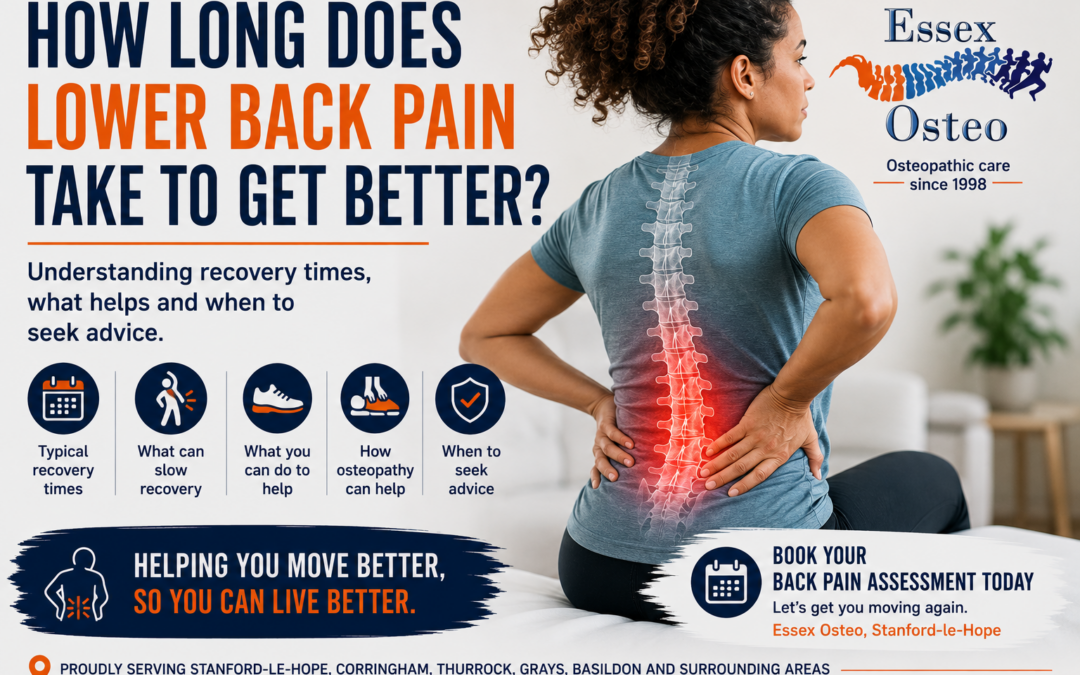
How Long Does Lower Back Pain Take to Get Better?
Understanding Recovery Times, What Helps and When to Seek Advice
If you’ve developed lower back pain, one of the first questions you’re likely to ask is:
“How long is this going to last?”
For many people, the answer is reassuring. Most episodes of uncomplicated lower back pain improve substantially over the first few weeks. However, recovery isn’t always a straight line, and some people continue to experience symptoms or have recurring episodes.
At Essex Osteo in Stanford-le-Hope, we regularly see people worried that their back isn’t recovering quickly enough. Understanding what’s normal, what can slow recovery and when you should seek professional advice can make back pain considerably less worrying.
How Long Does Lower Back Pain Usually Last?
Back pain is commonly described according to how long symptoms have been present:
Acute back pain
Usually refers to symptoms lasting less than six weeks.
Subacute back pain
Generally describes symptoms lasting approximately 6–12 weeks.
Persistent or chronic back pain
Usually refers to symptoms continuing for more than 12 weeks.
These categories don’t mean your back suddenly becomes more serious at a particular point. They’re simply useful ways of describing the duration of symptoms.
Many people experience significant improvement during the first few weeks.
Does Back Pain Normally Get Better on Its Own?
Often, yes.
Many episodes of uncomplicated mechanical lower back pain improve naturally.
Your back is a strong, adaptable structure, and pain following a strain or irritation doesn’t necessarily mean you’ve caused significant damage.
Recovery may involve:
- Gradually reducing pain
- Improved movement
- Increasing walking tolerance
- Returning to work
- Returning to exercise
- Regaining confidence in your back
However, improvement doesn’t always happen at the same speed for everyone.
Why Is My Back Pain Taking So Long to Improve?
There isn’t one universal recovery time because back pain has many possible causes.
Factors that may influence recovery include:
- The original injury or irritation
- Severity of symptoms
- Previous episodes of back pain
- Physical activity levels
- General health
- Sleep
- Work demands
- Stress
- Confidence about movement
- Muscle strength and conditioning
- How quickly normal activity is resumed
Sometimes there isn’t one damaged structure that needs to “heal”. Back pain can be influenced by several physical and lifestyle factors at the same time.
Does Severe Back Pain Mean a Longer Recovery?
Not necessarily.
Pain intensity doesn’t always reflect the amount of tissue damage.
A relatively minor irritation can sometimes produce considerable pain, muscle spasm and difficulty moving.
Equally, MRI scans frequently demonstrate structural changes in people who experience little or no pain.
This is one reason we assess the person rather than simply judging the problem by pain severity or imaging findings.
Should I Rest Until My Back Pain Goes Away?
Usually, prolonged bed rest isn’t recommended for uncomplicated lower back pain.
Although taking things slightly easier for a short period may be sensible, remaining inactive for too long can contribute to:
- Stiffness
- Reduced muscle strength
- Loss of confidence
- Slower return to normal activity
Current back pain management generally encourages people to remain active within tolerable limits.
This might initially mean gentle walking and everyday movement before gradually returning to normal exercise.
Is Walking Good for Lower Back Pain?
For many people, yes.
Walking is simple, accessible and allows you to remain active without needing specialist equipment.
You could begin with several shorter walks rather than trying to complete one long walk.
For example:
5–10 minutes several times during the day
may initially be more comfortable than walking continuously for 30–40 minutes.
The aim is gradually to increase what your back can tolerate.
Should I Exercise With Back Pain?
In most cases, some form of exercise is beneficial.
The right exercise depends on:
- Your symptoms
- Your diagnosis
- Current fitness
- Work demands
- Activities you want to return to
Your programme might include:
- Walking
- Mobility exercises
- Core strengthening
- Glute strengthening
- Hip exercises
- General resistance training
- Gradual return to sport
There isn’t one magical exercise that fixes every type of back pain.
An individual programme is generally more useful than simply searching online for “the best back exercise”.
Read our related guide: Best Exercises for Low Back Pain.
Is It Normal for Back Pain to Come and Go During Recovery?
Yes.
Recovery from back pain is rarely perfectly linear.
You might feel considerably better for several days and then experience increased symptoms following:
- More activity
- Gardening
- Sport
- A long drive
- Sitting at work
- Poor sleep
- An unusually busy day
A temporary increase in symptoms doesn’t necessarily mean you’ve damaged your back again or returned to the beginning.
Look at the overall trend.
Are you gradually able to:
- Walk further?
- Sit longer?
- Sleep better?
- Work more comfortably?
- Exercise more?
- Move with greater confidence?
These can be more useful measures of recovery than pain alone.
Why Does My Back Pain Keep Coming Back?
Back pain recurrence is common.
This doesn’t necessarily mean your previous treatment failed.
Contributing factors may include:
- Sudden increases in activity
- Reduced physical conditioning
- Prolonged inactivity
- Changes in work demands
- Heavy lifting
- Reduced sleep
- Previous back pain history
This is why rehabilitation shouldn’t simply stop when the pain disappears.
Building strength, movement capacity and confidence may help reduce the impact of future episodes.
Does a Disc Bulge Take Longer to Recover?
Not necessarily.
Disc bulges and disc degeneration are extremely common, including in people without symptoms.
When a disc problem irritates a spinal nerve and causes sciatica, recovery may sometimes take longer than uncomplicated back pain.
However, many disc-related problems improve without surgery.
The important question isn’t simply whether an MRI shows a disc bulge.
It’s whether the scan finding matches your symptoms and clinical examination.
Read our guides:
Slipped Disc or Herniated Disc – What Does It Mean?
and
Understanding Your MRI Report.
How Long Does Sciatica Take to Recover?
Sciatica can take longer to settle than straightforward mechanical back pain.
Some people improve within several weeks, while others experience symptoms for a few months.
Recovery depends on factors including:
- Degree of nerve irritation
- Presence of weakness
- Duration of symptoms
- General health
- Activity levels
Progressive muscle weakness or significant neurological changes require further assessment.
When Should I See an Osteopath About Back Pain?
You don’t necessarily need to wait several weeks before seeking help.
Consider arranging an assessment if:
- You’re unsure what’s causing the pain
- Pain is limiting normal activity
- You’re struggling to work
- Symptoms aren’t improving
- Back pain keeps returning
- You’re experiencing leg pain
- You’re worried about your symptoms
- You want advice about safely returning to exercise
Early assessment can provide reassurance, identify potential contributing factors and give you a structured recovery plan.
What Happens During a Back Pain Assessment?
At Essex Osteo, we don’t simply ask where it hurts and start treatment.
Your assessment may include:
- Detailed medical history
- Discussion about how symptoms started
- Screening for serious pathology
- Spinal movement assessment
- Hip and pelvic assessment
- Neurological examination where appropriate
- Muscle strength testing
- Functional movement assessment
We then explain what we think is happening and discuss your treatment options.
Can Osteopathy Help Back Pain Recover?
Osteopathic care may form part of a broader treatment programme for appropriate mechanical back pain.
Depending on your assessment, treatment may include:
- Joint mobilisation
- Manipulation where appropriate
- Soft tissue treatment
- Dry needling where appropriate
- Mobility exercises
- Strengthening
- Rehabilitation
- Advice about work and activity
- Strategies for returning to exercise
Hands-on treatment isn’t intended to replace exercise and self-management.
For many patients, the most useful approach combines symptom management with progressive rehabilitation.
What Can I Do to Help My Back Recover?
For uncomplicated back pain, useful strategies often include:
Keep moving
Avoid spending long periods completely inactive.
Gradually increase activity
Build walking, work and exercise tolerance progressively.
Exercise
Strengthening your back, hips and legs can improve your overall physical capacity.
Sleep well
Pain and poor sleep can influence each other, so maintaining a regular sleep routine may help.
Don’t panic about every flare-up
Temporary increases in symptoms can occur during recovery.
Understand your back
Knowing that most back pain isn’t caused by serious damage can help restore confidence in movement.
Do I Need an X-Ray or MRI If My Back Isn’t Getting Better?
Not automatically.
Most uncomplicated lower back pain doesn’t require imaging.
An X-ray or MRI may be considered when the results are likely to change your treatment or management.
Imaging may be appropriate when there are significant neurological findings, suspected serious pathology or when specialist intervention is being considered.
We’ve created two detailed guides explaining this:
Do I Need an MRI for Back Pain?
Can an X-Ray Diagnose Back Pain?
When Should I Be Concerned About Back Pain?
Although most back pain isn’t serious, certain symptoms require urgent assessment.
Seek urgent medical attention if you develop:
- New difficulty controlling your bladder or bowels
- Numbness around the genitals, buttocks or saddle region
- Progressive weakness in one or both legs
- Severe symptoms following significant trauma
- Back pain accompanied by significant systemic illness
Other symptoms such as unexplained weight loss, fever or persistent pain in someone with relevant medical history may also require medical assessment.
Read our full guide:
When Is Back Pain Serious? Red Flags You Should Never Ignore.
What If I’ve Had Back Pain for More Than 12 Weeks?
Persistent pain doesn’t automatically mean there is permanent damage.
Longer-term back pain can be influenced by multiple factors, including:
- Strength and conditioning
- Movement habits
- Sleep
- Work demands
- General health
- Previous episodes
- Fear of movement
- Reduced activity
Treatment often focuses less on trying to identify one “damaged” structure and more on gradually improving function, strength, confidence and quality of life.
Can You Fully Recover From Lower Back Pain?
Yes.
Many people return to:
- Work
- Running
- Gym training
- Golf
- Gardening
- Cycling
- Sport
- Normal family life
even after significant episodes of back pain.
Some people experience occasional recurrences, but knowing how to manage them can make future episodes considerably less disruptive.
The goal isn’t necessarily to create a back that never aches again.
It’s to develop a strong, confident and capable back that doesn’t prevent you living your life.
Why Choose Essex Osteo for Back Pain?
Essex Osteo has been providing osteopathic care in Stanford-le-Hope since 1998.
We regularly help people experiencing:
- Acute lower back pain
- Persistent back pain
- Sciatica
- Disc-related pain
- Facet joint pain
- Sacroiliac joint pain
- Spinal arthritis
- Lumbar spinal stenosis
Our approach combines comprehensive assessment, evidence-informed osteopathic treatment, rehabilitation and practical self-management advice.
Patients visit us from Stanford-le-Hope, Corringham, Thurrock, Grays, Basildon and surrounding areas.
Frequently Asked Questions
How long should lower back pain last?
Many episodes improve substantially within several weeks, although recovery times vary. Some people experience symptoms for longer without this necessarily indicating serious damage.
Is back pain lasting two weeks normal?
It can be. Back pain often takes several weeks to settle. However, you can arrange an assessment sooner if symptoms are severe, limiting your activity or causing concern.
Why is my back still hurting after six weeks?
There are many possibilities. Persistent symptoms don’t automatically mean something serious is wrong, but an assessment can help identify contributing factors and guide rehabilitation.
Should I keep working with back pain?
Remaining active is generally encouraged, although temporary adjustments may be necessary depending on your symptoms and occupation.
Is it normal to have good and bad days?
Yes. Fluctuating symptoms are common during recovery and don’t necessarily mean your condition is deteriorating.
Will I need an MRI if my pain doesn’t improve?
Not necessarily. Imaging is usually considered when it is likely to change clinical management rather than simply because pain has lasted a particular number of weeks.
Can osteopathy help persistent back pain?
For appropriate musculoskeletal conditions, osteopathic treatment may form part of a broader programme involving exercise, rehabilitation, education and self-management.
Book a Back Pain Assessment in Stanford-le-Hope
If your back pain isn’t improving as quickly as you’d hoped—or you’re simply unsure what you should be doing—Essex Osteo can help.
We’ll assess your symptoms, explain what is likely to be happening and develop a personalised plan aimed at getting you moving again.
You don’t have to wait until your back pain becomes chronic before seeking advice.
Essex Osteo – Stanford-le-Hope
Providing osteopathic care since 1998.
Move better. Feel better. Live better.
Internal Linking Strategy
For maximum SEO and AI-search value, link this article to:
- The Complete Guide to Low Back Pain — main pillar page
- What Causes Low Back Pain?
- Mechanical Low Back Pain Explained
- Best Exercises for Low Back Pain
- How Osteopathy Helps Low Back Pain
- How to Prevent Back Pain
- Sciatica: Causes, Symptoms and Treatment
- Slipped Disc or Herniated Disc
- Do I Need an MRI for Back Pain?
- Understanding Your MRI Report
- Can an X-Ray Diagnose Back Pain?
- When Is Back Pain Serious?
I’d also add a link from your main Low Back Pain pillar page back to this article, using natural anchor text such as “how long lower back pain takes to recover.”
SEO Title
How Long Does Lower Back Pain Take to Get Better? | Essex Osteo
Meta Description
How long does lower back pain last? Learn typical recovery times, what can slow recovery, when to seek help and how osteopathy may help. Essex Osteo, Stanford-le-Hope.
Suggested URL
/how-long-does-lower-back-pain-last/