
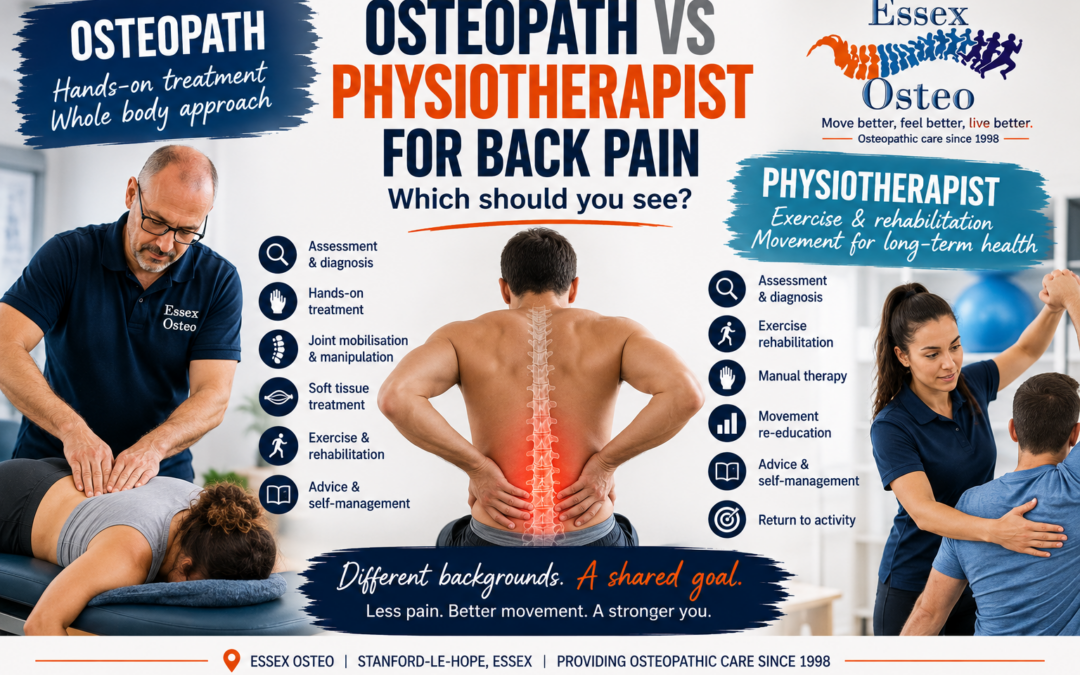
Osteopath vs Physiotherapist for Back Pain – Which Should I See?
Understanding the Differences, Similarities and Which May Be Right for You
If you have lower back pain, sciatica or a recurring back problem, you may be wondering:
“Should I see an osteopath or a physiotherapist?”
It’s an understandable question. Both professions regularly assess and treat people with musculoskeletal problems, and there can be considerable overlap between the treatments they provide.
The reality is that there isn’t a simple answer that one profession is always better than the other. For many types of back pain, the experience of the individual practitioner, the quality of the assessment and whether treatment includes appropriate rehabilitation may be more important than whether the clinician is an osteopath or physiotherapist.
At Essex Osteo in Stanford-le-Hope, our approach combines detailed musculoskeletal assessment, hands-on osteopathic treatment where appropriate, exercise rehabilitation, education and self-management.
This guide explains the similarities and differences between osteopathy and physiotherapy and helps you decide which may be appropriate for your back pain.
What Is an Osteopath?
An osteopath is a healthcare professional trained to assess, diagnose and manage problems involving the musculoskeletal system.
In the UK, the title osteopath is protected by law, and practitioners must be registered with the General Osteopathic Council (GOsC).
Osteopaths commonly see people experiencing:
- Lower back pain
- Neck pain
- Sciatica
- Joint pain
- Muscle problems
- Sports injuries
- Shoulder problems
- Hip and knee pain
Although osteopathy is often associated with hands-on treatment, modern osteopathic management can also incorporate exercise, rehabilitation, education and advice.
What Is a Physiotherapist?
Physiotherapists are healthcare professionals who assess and manage a wide variety of conditions affecting movement and function.
Physiotherapy covers a particularly broad range of healthcare, including:
- Musculoskeletal conditions
- Neurological rehabilitation
- Respiratory conditions
- Rehabilitation following surgery
- Sports injuries
- Orthopaedics
- Older-person rehabilitation
Physiotherapists specialising in musculoskeletal (MSK) physiotherapy commonly assess and treat the same back, neck, joint and sports-related conditions seen by osteopaths.
Physiotherapists in the UK are regulated by the Health and Care Professions Council (HCPC).
Osteopath vs Physiotherapist – What’s the Difference?
Historically, osteopathy and physiotherapy developed from different traditions.
However, modern musculoskeletal practice has increasingly brought the two professions closer together.
Both may use:
- Clinical assessment
- Movement testing
- Exercise
- Rehabilitation
- Manual therapy
- Joint mobilisation
- Soft tissue techniques
- Education
- Self-management advice
The precise treatment you receive may therefore depend more on the individual practitioner than their professional title.
Osteopath vs Physiotherapist for Back Pain
Here is a simple comparison:
| Osteopath | MSK Physiotherapist | |
|---|---|---|
| Assess back pain | ✅ | ✅ |
| Treat mechanical back pain | ✅ | ✅ |
| Assess sciatica | ✅ | ✅ |
| Exercise rehabilitation | ✅ | ✅ |
| Manual therapy | Commonly | Commonly |
| Joint mobilisation | ✅ | ✅ |
| Spinal manipulation | Commonly used by appropriately trained osteopaths | Some appropriately trained physiotherapists |
| Soft tissue treatment | ✅ | ✅ |
| Advice and education | ✅ | ✅ |
| Neurological assessment | Where appropriate | Where appropriate |
| Refer onwards when required | ✅ | ✅ |
There is clearly substantial overlap.
So rather than asking:
“Which profession is better?”
a more useful question may be:
“Which practitioner offers the assessment and management approach that best suits my problem?”
Is an Osteopath Better for Hands-On Treatment?
Osteopaths traditionally receive extensive training in manual examination and hands-on techniques.
These may include:
- Joint mobilisation
- Spinal manipulation
- Soft tissue techniques
- Muscle energy techniques
- Articulation
- Stretching
However, many musculoskeletal physiotherapists also have extensive postgraduate training in manual therapy.
Equally, not every patient needs hands-on treatment.
Current approaches to back pain generally encourage manual therapy to be combined with exercise and self-management rather than used as a stand-alone treatment.
Are Physiotherapists Better at Exercise Rehabilitation?
Physiotherapy has traditionally had a particularly strong emphasis on rehabilitation and exercise.
However, exercise rehabilitation is also an important component of modern osteopathic practice.
At Essex Osteo, treatment isn’t simply about reducing today’s pain.
Depending on your condition, rehabilitation may include:
- Core strengthening
- Hip and glute strengthening
- Mobility work
- General resistance exercise
- Balance and control
- Functional rehabilitation
- Return-to-running programmes
- Return-to-sport rehabilitation
The goal is to improve your ability to tolerate the activities that matter to you.
What About Spinal Manipulation?
Spinal manipulation is frequently associated with osteopathy.
It involves applying a controlled movement to a spinal joint and may sometimes produce an audible “click”.
But manipulation isn’t necessary for every patient.
It should only be used when:
- Clinically appropriate
- Suitable for the patient
- There are no relevant contraindications
- The patient is comfortable with the technique
Some physiotherapists also undertake postgraduate training in spinal manipulation.
At Essex Osteo, you don’t have to have your back manipulated simply because you’ve booked an osteopathy appointment.
Which Is Better for Sciatica?
Both appropriately trained osteopaths and musculoskeletal physiotherapists can assess people with sciatica.
The initial priority isn’t deciding which profession is better.
It’s determining:
Is this actually sciatica?
Sciatica usually results from irritation or compression of a spinal nerve root and may cause:
- Leg pain
- Tingling
- Pins and needles
- Numbness
- Occasionally weakness
Assessment may therefore include:
- Muscle strength
- Reflexes
- Sensation
- Nerve sensitivity
- Spinal movement
- Functional testing
Significant or progressive neurological symptoms may require further medical investigation rather than simply more treatment.
Which Is Better for a Slipped Disc?
Again, neither profession is automatically better.
A “slipped disc”, more accurately called a disc herniation or prolapse, can often be managed conservatively.
Treatment may involve:
- Remaining appropriately active
- Exercise
- Rehabilitation
- Education
- Pain-management strategies
- Manual therapy where appropriate
The important factor is receiving an accurate assessment and monitoring for neurological symptoms.
Most people with a disc herniation do not automatically require surgery.
What About Long-Term Back Pain?
Persistent back pain often requires more than passive treatment.
If you’ve experienced pain for months or years, management may need to consider:
- Strength
- Physical conditioning
- Activity levels
- Sleep
- Work demands
- Previous episodes
- Confidence in movement
- General health
- Lifestyle factors
Whether you see an osteopath or physiotherapist, a good treatment plan should help you gradually become more independent rather than dependent on repeated treatment.
Do Osteopaths and Physiotherapists Diagnose Conditions?
Both professions assess patients and make clinical decisions within their respective scopes of practice.
For musculoskeletal back pain, this may involve determining whether symptoms are consistent with conditions such as:
- Mechanical lower back pain
- Sciatica
- Disc-related problems
- Facet joint pain
- Sacroiliac joint pain
- Lumbar spinal stenosis
- Hip-related pain
Just as importantly, both professions should recognise when symptoms don’t fit a routine musculoskeletal presentation and require medical investigation.
Do I Need an X-Ray or MRI First?
Usually not.
Most uncomplicated lower back pain doesn’t require imaging before seeing either an osteopath or physiotherapist.
National guidance advises against routine imaging for non-specific low back pain unless the results are likely to change management.
An appropriate clinical assessment should generally come first.
Imaging may become necessary where there is concern about:
- Significant neurological compromise
- Fracture
- Infection
- Cancer
- Inflammatory disease
- Other serious pathology
We’ve covered this in our guides:
Do I Need an MRI for Back Pain?
and
Can an X-Ray Diagnose Back Pain?
When Should I See My GP Instead?
Your GP or another appropriate medical professional may be the better starting point when:
- You’re systemically unwell
- Medication requires review
- Serious pathology is suspected
- Further medical investigations are required
- Symptoms aren’t clearly musculoskeletal
Depending on local services, you may also have access to an MSK First Contact Practitioner (FCP) through your GP surgery.
FCPs provide advanced musculoskeletal assessment and can help determine whether you need conservative treatment, investigations or onward referral.
When Is Back Pain an Emergency?
Neither a routine osteopathy nor physiotherapy appointment should delay emergency medical assessment when serious neurological symptoms develop.
Seek urgent medical attention if you experience:
🚩 New difficulty controlling your bladder or bowels
🚩 Numbness around the genitals, buttocks or inner thighs
🚩 Progressive weakness affecting one or both legs
🚩 Severe symptoms following significant trauma
These symptoms can indicate serious conditions such as cauda equina syndrome and require urgent assessment.
Our guide When Is Back Pain Serious? Red Flags You Should Never Ignore explains this in greater detail.
Which Should I Choose: Osteopath or Physiotherapist?
For straightforward musculoskeletal back pain, either may be appropriate.
Instead of focusing exclusively on the profession, consider asking:
Does the practitioner regularly treat back pain?
Experience with your particular condition matters.
Will they assess me properly?
Treatment shouldn’t begin without understanding your symptoms and relevant medical history.
Do they provide rehabilitation?
Exercise and self-management should form an important part of modern back pain care.
Will they explain what’s happening?
You should leave understanding your condition rather than feeling frightened about your spine.
Will they refer me if necessary?
A good practitioner should recognise when your symptoms require medical investigation or specialist opinion.
Will treatment be reviewed?
You shouldn’t simply be booked indefinitely without reassessing whether you’re improving.
What Makes the Approach at Essex Osteo Different?
At Essex Osteo, our approach draws on extensive experience across both osteopathic and NHS musculoskeletal practice.
Ben Calvert-Painter has worked as a Registered Osteopath since 1998 and also works within NHS musculoskeletal services, including advanced MSK/FCP practice alongside physiotherapists and other healthcare professionals.
This means our approach isn’t based on the idea that one profession has all the answers.
Instead, we combine:
- Detailed musculoskeletal assessment
- Osteopathic manual therapy where appropriate
- Rehabilitation
- Exercise
- Dry needling where appropriate
- Patient education
- Self-management
- Recognition of when further investigation or referral is necessary
Our aim is to choose the approach that is appropriate for the patient in front of us.
What Happens If Osteopathy Isn’t the Right Treatment?
We’ll tell you.
Sometimes assessment suggests that:
- Further medical investigation is needed
- Imaging may be appropriate
- Another healthcare professional is better placed to manage the condition
- Specialist referral should be considered
Knowing when not to treat is an important part of safe musculoskeletal healthcare.
Should I Choose Based on Who Can “Fix” My Back?
Probably not.
Back pain isn’t usually as simple as one joint being “out of place” and needing to be put back.
Modern understanding of back pain recognises that symptoms may be influenced by multiple factors.
Rather than trying to repeatedly “fix” your spine, treatment should aim to help you:
Move better.
Become stronger.
Understand your symptoms.
Return to normal activities.
Manage future flare-ups confidently.
Frequently Asked Questions
Is an osteopath or physiotherapist better for lower back pain?
Neither profession is universally better. Both can manage musculoskeletal back pain. The clinician’s experience, assessment and treatment approach are often more important than the professional title.
Who is better for sciatica?
Both appropriately trained osteopaths and MSK physiotherapists can assess and conservatively manage many cases of sciatica. Significant neurological symptoms may require medical investigation.
Are osteopaths more hands-on than physiotherapists?
Osteopathy traditionally places considerable emphasis on manual therapy, but many MSK physiotherapists also use hands-on techniques.
Do osteopaths give exercises?
Yes. Modern osteopathic management can include strengthening, mobility, rehabilitation and self-management exercises.
Do physiotherapists manipulate backs?
Some physiotherapists undertake additional training in spinal manipulation and use it where appropriate.
Can I see an osteopath without seeing my GP?
Yes. In private practice, you can normally book directly with a Registered Osteopath without a GP referral.
Do I need an MRI before seeing either?
Usually not. Most uncomplicated back pain doesn’t require imaging before assessment.
What if I’ve already tried physiotherapy?
That doesn’t necessarily mean another conservative approach cannot help. A fresh assessment may identify different contributing factors or rehabilitation priorities. Equally, if treatment isn’t progressing as expected, further investigation or another clinical opinion may sometimes be appropriate.
Osteopath for Back Pain in Stanford-le-Hope
If you’re experiencing lower back pain, sciatica or recurring symptoms and aren’t sure who you should see, Essex Osteo can help you understand your options.
We’ll start with a comprehensive assessment, explain what we think is contributing to your symptoms and develop an individual treatment and rehabilitation plan where osteopathic care is appropriate.
And if we think you need a different healthcare professional or further investigation, we’ll advise you accordingly.
Essex Osteo – Stanford-le-Hope
Providing osteopathic care since 1998, helping patients from Corringham, Thurrock, Grays, Basildon and surrounding areas.
Move better. Feel better. Live better.
SEO setup
SEO title:
Osteopath vs Physiotherapist for Back Pain – Which Is Better? | Essex Osteo
Meta description:
Osteopath or physiotherapist for back pain? Discover the differences, similarities and which practitioner may be right for lower back pain or sciatica. Essex Osteo, Stanford-le-Hope.
Suggested URL:
/osteopath-vs-physiotherapist-back-pain/