
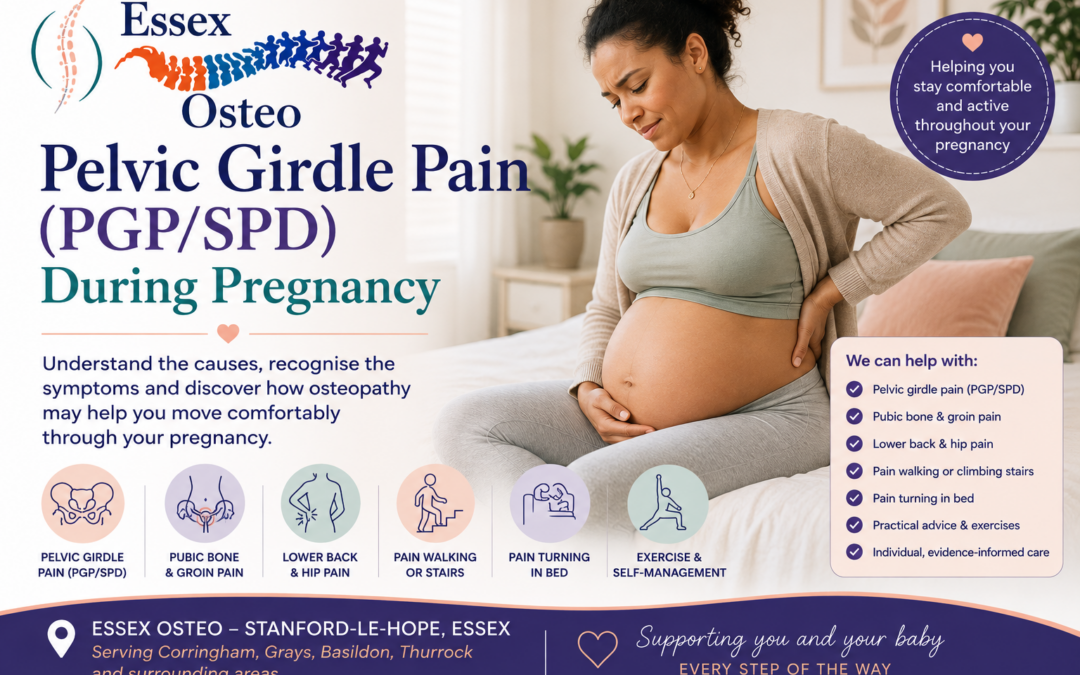
Pelvic Girdle Pain (PGP/SPD) During Pregnancy: Causes, Symptoms, Treatment & How Osteopathy May Help
A Guide for Expectant Mothers from Essex Osteo, Stanford-le-Hope
Are you experiencing pain around your pelvis during pregnancy? Does it hurt when you walk, climb stairs, turn over in bed or get out of the car?
You may be experiencing pregnancy-related pelvic girdle pain (PGP).
Pelvic girdle pain is a relatively common musculoskeletal problem during pregnancy and can range from a mild ache to pain that significantly affects walking, sleeping, working and everyday activities.
You may also have heard the condition referred to as SPD (Symphysis Pubis Dysfunction). Although SPD is still commonly used by patients, Pregnancy-Related Pelvic Girdle Pain (PGP) is the broader term now generally used to describe pain arising around the joints and surrounding tissues of the pelvis during pregnancy.
At Essex Osteo in Stanford-le-Hope, we assess and treat expectant mothers experiencing pregnancy-related back, hip and pelvic pain.
This guide explains what PGP is, why it happens, what symptoms to look out for and how osteopathy, exercise and practical self-management may help.
What Is Pelvic Girdle Pain During Pregnancy?
The pelvic girdle consists of several bones and joints that work together to transfer forces between your spine and legs.
These include the:
- Sacroiliac joints at the back of the pelvis
- Pubic symphysis at the front
- Sacrum
- Pelvic bones
- Surrounding muscles and ligaments
During pregnancy, your body has to adapt to changes in weight, posture, movement and physical load.
For some women, these changes are associated with pain around the pelvis.
PGP doesn’t necessarily mean that your pelvis is damaged or unstable. Pain is influenced by a combination of mechanical, muscular and individual factors, and many women can be successfully managed with appropriate advice, activity modification and treatment.
Is PGP the Same as SPD?
Not exactly.
SPD (Symphysis Pubis Dysfunction) traditionally describes symptoms concentrated around the pubic symphysis at the front of the pelvis.
Pelvic Girdle Pain (PGP) is a broader term that includes pain arising from the front, back or both sides of the pelvic girdle.
Many people still search online for terms such as:
- SPD in pregnancy
- Symphysis pubis pain
- Pubic bone pain during pregnancy
- Pelvic pain during pregnancy
So although healthcare professionals increasingly use the term PGP, you may still hear both expressions.
What Does Pelvic Girdle Pain Feel Like?
Symptoms vary considerably between women.
Pain may be felt around the:
- Pubic bone
- Groin
- Lower back
- Sacroiliac joints
- Buttocks
- Hips
- Inner thighs
- Perineal region
Some women describe aching or stiffness, while others experience sharper pain during particular movements.
Common Symptoms of PGP During Pregnancy
You may notice pain when:
- Walking
- Climbing stairs
- Turning over in bed
- Getting into or out of a car
- Standing on one leg
- Getting dressed
- Putting on shoes
- Getting out of a chair
- Walking longer distances
- Carrying another child
- Moving your legs apart
Some women also report clicking or grinding sensations around the pelvis.
These symptoms can be uncomfortable and sometimes worrying, but they do not automatically mean that something is being damaged.
What Causes Pelvic Girdle Pain?
There is unlikely to be one single cause.
Several factors may contribute.
Hormonal Changes
Hormonal changes during pregnancy affect connective tissues and prepare your body for childbirth.
Relaxin is often blamed entirely for PGP, but the condition is more complex than simply having “loose ligaments”.
Hormonal changes occur alongside alterations in movement, muscular demand and physical loading.
Your Growing Baby
As pregnancy progresses, your body is supporting increasing weight.
Your centre of gravity changes and your muscles adapt to different physical demands.
Changes in Movement
You may gradually change the way you:
- Walk
- Stand
- Sit
- Sleep
- Climb stairs
- Lift
Some movement patterns may become uncomfortable as pregnancy progresses.
Previous Back or Pelvic Pain
Women with a previous history of lower back or pelvic pain may have an increased likelihood of experiencing symptoms during pregnancy.
This doesn’t mean that PGP is inevitable, but previous symptoms are worth discussing during assessment.
Is My Pelvis “Out of Alignment”?
This is a common concern.
PGP is sometimes explained as the pelvis being “out”, “twisted” or “unstable”.
These explanations can make women unnecessarily worried about movement.
The pelvis is a strong structure designed to manage considerable forces.
At Essex Osteo, our aim isn’t simply to “put your pelvis back into place”. Instead, we assess how your back, pelvis, hips and surrounding muscles are functioning and look for practical ways of improving comfort and movement.
Can Osteopathy Help Pelvic Girdle Pain During Pregnancy?
Osteopathic care may form part of the management of pregnancy-related pelvic girdle pain.
Treatment begins with an individual assessment to understand your symptoms and identify movements or activities that may be contributing to them.
Depending on your findings, osteopathic care may include:
- Gentle joint mobilisation
- Soft tissue techniques
- Muscle relaxation techniques
- Hip and spinal mobility work
- Exercise advice
- Movement strategies
- Postural advice
- Activity modification
- Self-management guidance
Treatment is adapted to your pregnancy and comfort.
The goal is to help you remain comfortable, confident and active, rather than encouraging unnecessary fear or avoidance of movement.
Is Osteopathy Safe for PGP During Pregnancy?
For many women, osteopathic treatment can be provided safely during pregnancy following an appropriate assessment.
Your treatment is modified according to:
- Stage of pregnancy
- Medical history
- Symptoms
- Comfort
- Individual preferences
As your bump grows, treatment positions are adapted so that you remain comfortably supported.
For more information, read our related guide:
Is Osteopathy Safe During Pregnancy?
Should I Exercise With Pelvic Girdle Pain?
In many cases, yes.
Avoiding all activity is rarely necessary.
Appropriate exercise may help maintain:
- Strength
- Mobility
- Confidence
- General fitness
- Function
The important point is finding the right level of activity for you.
If an exercise significantly aggravates your symptoms, it may need to be modified rather than automatically abandoned altogether.
Practical Tips for Managing PGP
Small changes can sometimes make everyday activities considerably easier.
Turning Over in Bed
Try moving your shoulders and pelvis together rather than twisting sharply.
Some women find placing a pillow between their knees comfortable.
Getting Out of the Car
Instead of stepping one leg out at a time and twisting, try turning your whole body towards the door before standing.
Getting Dressed
If standing on one leg aggravates your symptoms, sit down when putting on trousers, socks and shoes.
Climbing Stairs
If stairs are painful, reduce unnecessary trips where practical and take your time.
Your healthcare professional may also suggest temporary modifications depending on your symptoms.
Avoid Staying Still for Too Long
Alternating between sitting, standing and walking may be more comfortable than remaining in one position for prolonged periods.
What About a Pelvic Support Belt?
Some women find a pelvic support belt helpful.
However, it isn’t automatically required for everyone with PGP.
The type of belt, positioning and circumstances in which you wear it can influence whether it is useful.
An individual assessment can help determine whether a support belt is worth considering.
Should I Rest If I Have PGP?
Complete rest is generally not the goal.
If certain activities significantly aggravate your symptoms, temporarily modifying them may be appropriate.
However, prolonged inactivity can lead to reduced strength, stiffness and loss of confidence with movement.
A better approach is often to find ways of remaining active within comfortable limits.
Can PGP Affect Labour?
Having PGP does not automatically mean you cannot have a vaginal birth.
Many women with pelvic girdle pain are able to give birth vaginally.
Discuss your symptoms with your midwife or maternity team so that comfortable labour and birth positions can be considered.
If certain hip positions are particularly painful, this information can also be useful when planning your care.
Does PGP Go Away After Pregnancy?
For many women, symptoms improve following birth as pregnancy-related physical demands change.
Some women, however, continue experiencing pelvic or lower back pain after delivery.
If symptoms persist, postnatal assessment and rehabilitation may be helpful.
We’ll cover this in greater detail in our upcoming guide to Postnatal Osteopathy and Recovery After Birth.
When Should Pelvic Pain During Pregnancy Be Medically Assessed?
Not every pain around the pelvis is PGP.
Seek advice from your maternity team, GP or appropriate urgent healthcare service if pelvic or back pain is associated with symptoms such as:
- Vaginal bleeding
- Fluid loss
- Regular contractions
- Severe abdominal pain
- Fever or feeling significantly unwell
- Pain when urinating
- Reduced fetal movements
- Significant new weakness or numbness
- Loss of bladder or bowel control
- Numbness around the saddle or genital area
If you’re unsure whether a symptom is musculoskeletal, seeking appropriate medical advice is sensible.
What Happens at Your First Appointment?
At Essex Osteo, your first pregnancy osteopathy appointment starts with a detailed consultation.
We’ll discuss:
- Your current pregnancy
- Your symptoms
- Previous pregnancies
- Previous back or pelvic problems
- Medical history
- Work
- Exercise
- Daily activities
- What makes your symptoms better or worse
We can then assess areas including your:
- Lower back
- Pelvis
- Sacroiliac joints
- Hips
- Surrounding muscles
- Movement patterns
We’ll explain our findings and discuss whether osteopathic treatment is appropriate.
Frequently Asked Questions About PGP/SPD
Is PGP dangerous for my baby?
Pregnancy-related musculoskeletal pelvic girdle pain does not usually mean that there is a problem with your baby. However, new or unusual pregnancy symptoms should always be discussed with your maternity team where appropriate.
Is SPD the same as pelvic girdle pain?
SPD refers specifically to symptoms around the pubic symphysis. PGP is the broader term used for pregnancy-related pain affecting the pelvic girdle.
Can osteopathy cure SPD?
It is more appropriate to talk about managing symptoms and improving function rather than promising a cure. Osteopathic treatment, exercise and activity modification may help some women manage PGP.
Should I avoid walking?
Not necessarily. Walking can usually be continued within comfortable limits. If longer walks aggravate your symptoms, modifying distance, pace or frequency may help.
Do I need a GP referral to see an osteopath?
No. You can normally book directly with a registered osteopath.
When should I seek treatment for PGP?
You don’t necessarily need to wait until your symptoms become severe. If pelvic pain is beginning to affect walking, sleeping, working or everyday activities, assessment may help you understand the problem and develop an appropriate management plan.
Pelvic Girdle Pain Treatment in Stanford-le-Hope
If pelvic girdle pain, SPD or pubic symphysis pain during pregnancy is affecting your ability to walk, sleep, work or enjoy your pregnancy, we’re here to help.
At Essex Osteo, we’ve been providing osteopathic care since 1998 from our clinic in Stanford-le-Hope, Essex.
We provide individual, evidence-informed assessment and treatment for expectant mothers experiencing:
- Pelvic girdle pain
- SPD
- Pregnancy back pain
- Hip and buttock pain
- Pregnancy-related sciatica
- Muscular aches and stiffness
We welcome patients from Stanford-le-Hope, Corringham, Grays, Thurrock, Basildon, Tilbury, South Ockendon and surrounding areas of Essex.
If you’re searching for a pregnancy osteopath near me, PGP treatment in Stanford-le-Hope, help with SPD in Thurrock or osteopathy for pelvic pain during pregnancy in Essex, contact Essex Osteo to arrange an assessment.
Essex Osteo – helping you stay comfortable, confident and moving throughout your pregnancy.
Continue Reading
This article forms part of our Complete Guide to Pregnancy & Baby Osteopathy series.
You may also find these guides helpful:
- The Complete Guide to Pregnancy & Baby Osteopathy
- Is Osteopathy Safe During Pregnancy?
- Back Pain During Pregnancy: Causes, Treatment & How Osteopathy May Help
- Sciatica During Pregnancy
- Rib Pain During Pregnancy
- Preparing Your Body for Labour
- Postnatal Osteopathy: Recovery After Birth