
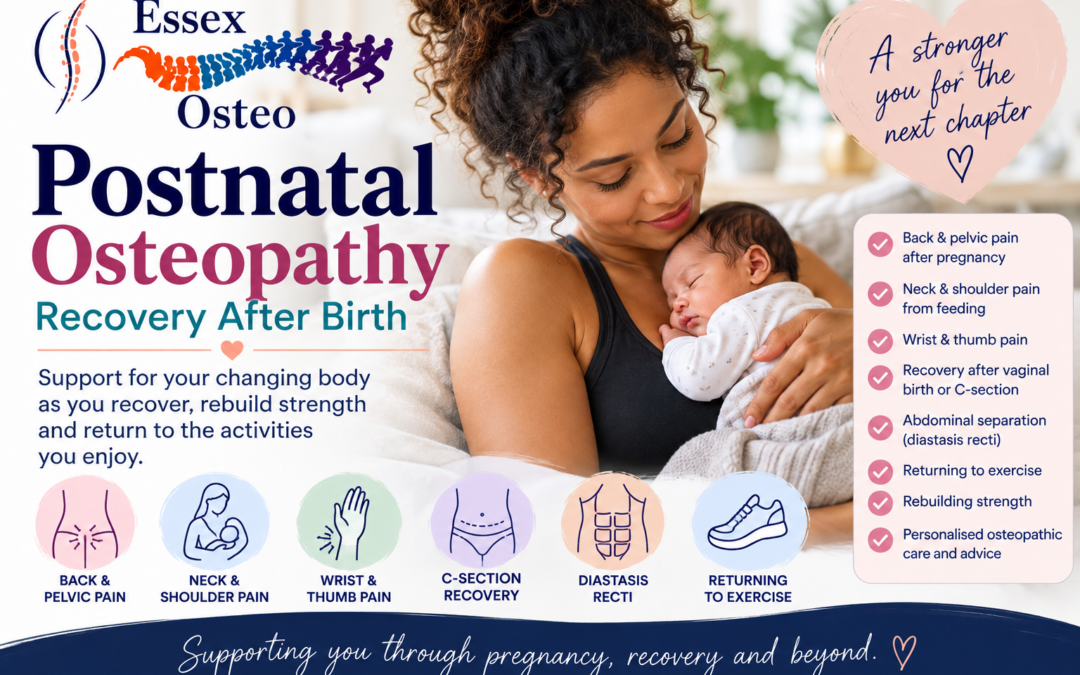
Postnatal Osteopathy: Recovery After Birth, Back Pain, Pelvic Pain & Returning to Exercise
A Guide for New Mums from Essex Osteo, Stanford-le-Hope
Having a baby places extraordinary demands on your body—and those demands don’t suddenly disappear once your baby arrives.
Whether you’ve had a vaginal birth, assisted delivery or Caesarean section, the weeks and months following childbirth involve another period of significant physical change.
At the same time, you’re suddenly spending hours feeding, carrying, lifting and settling your baby, often while getting considerably less sleep than usual.
It’s therefore not surprising that new mums frequently experience back pain, pelvic discomfort, neck and shoulder tension, wrist pain or difficulty returning comfortably to exercise.
At Essex Osteo in Stanford-le-Hope, we provide individual osteopathic assessment and treatment for women during pregnancy and after birth.
This guide explains some of the common postnatal musculoskeletal problems we see, how your body recovers following pregnancy and birth, and how osteopathy, movement and rehabilitation may support your recovery.
What Happens to Your Body After Giving Birth?
Pregnancy produces gradual changes over approximately nine months.
After your baby arrives, your body doesn’t instantly return to its pre-pregnancy state.
Recovery takes time.
Your:
- Abdominal muscles
- Pelvic floor
- Back
- Pelvis
- Hips
- Connective tissues
- Breathing mechanics
- General strength
all continue adapting after birth.
Add breastfeeding or bottle feeding, carrying a baby, lifting car seats and interrupted sleep, and the physical demands of early parenthood can be considerable.
Postnatal recovery should therefore be viewed as a process rather than a deadline.
Common Aches and Pains After Having a Baby
Lower Back Pain
Lower back pain is common after pregnancy.
Potential contributing factors include:
- Residual pregnancy-related symptoms
- Reduced activity around the time of delivery
- Feeding positions
- Repeated bending
- Lifting your baby
- Carrying car seats
- Reduced sleep
- Changes in strength and physical capacity
Pain doesn’t necessarily mean your back has been damaged during childbirth.
An assessment can help identify factors that may be contributing to persistent symptoms.
Pelvic Pain After Birth
Pregnancy-related Pelvic Girdle Pain (PGP/SPD) often improves after delivery, but some women continue experiencing symptoms.
Pain may occur around the:
- Pubic bone
- Sacroiliac region
- Buttocks
- Groin
- Hips
- Lower back
If pelvic pain continues after birth, it doesn’t necessarily mean your pelvis remains “out of alignment”.
Recovery may involve gradually rebuilding movement, strength and confidence alongside appropriate treatment where needed.
Neck and Shoulder Pain From Feeding
New parents can spend several hours each day feeding their baby.
Whether breastfeeding or bottle feeding, repeatedly looking down while supporting your baby can contribute to:
- Neck pain
- Shoulder tension
- Upper-back discomfort
- Headaches
- Arm fatigue
There’s no single perfect feeding posture.
Instead, aim to find a comfortable position where your baby is well supported and your shoulders can relax.
Using cushions and changing position regularly can help.
Wrist and Thumb Pain After Having a Baby
Pain around the wrist or thumb is another common complaint among new parents.
Repeatedly:
- Lifting your baby
- Supporting their head
- Holding them during feeding
- Carrying them
- Picking them up from a cot
can significantly increase the demands placed on your hands and wrists.
One condition associated with this period is De Quervain’s tenosynovitis, sometimes informally called “mother’s thumb”.
Early advice regarding lifting technique and load management can be helpful.
What About C-Section Recovery?
A Caesarean section is major abdominal surgery, and recovery deserves time.
During the early stages, follow the advice provided by your maternity team regarding:
- Wound care
- Activity
- Lifting
- Driving
- Exercise
- Signs of infection
As healing progresses, some women notice:
- Abdominal sensitivity
- Tightness around the scar
- Altered sensation
- Back discomfort
- Reduced confidence with movement
- Reduced abdominal strength
Rehabilitation should be gradual and appropriate for your individual recovery.
Osteopathy does not accelerate surgical wound healing, and treatment should not be performed directly over a C-section wound until it has appropriately healed.
Later in recovery, assessment may consider your overall movement, back, hips, abdominal function and the tissues surrounding the healed scar where appropriate.
Recovery After a Vaginal Birth
Vaginal birth also places significant physical demands on the body.
Recovery can vary enormously depending on factors such as:
- Duration of labour
- Position during labour
- Perineal tears
- Episiotomy
- Forceps or ventouse delivery
- Previous pregnancy-related pain
It’s important not to compare your recovery with somebody else’s.
If you’re experiencing ongoing pelvic floor symptoms, significant perineal pain or concerns about prolapse, assessment by an appropriately qualified pelvic health physiotherapist may be particularly valuable.
Osteopathy should complement—not replace—specialist pelvic health care where it is required.
Can Osteopathy Help After Pregnancy?
Osteopathic treatment may form part of the management of postnatal musculoskeletal pain and movement difficulties.
At Essex Osteo, your treatment is based on an individual assessment rather than assuming that childbirth has “put your body out”.
Depending on your symptoms, we may assess your:
- Spine
- Pelvis
- Hips
- Rib cage
- Neck and shoulders
- Muscular function
- Movement
- Strength and rehabilitation needs
Treatment may include:
- Joint mobilisation
- Soft tissue techniques
- Movement advice
- Exercise rehabilitation
- Strengthening
- Advice about lifting and carrying
- Feeding-position modifications
- Self-management strategies
Our goal is to help you move comfortably and progressively rebuild your physical capacity.
When Can I See an Osteopath After Giving Birth?
There isn’t one universal time when every woman should have osteopathic treatment after birth.
It depends on:
- How you gave birth
- Your recovery
- Your symptoms
- Whether you had surgery
- Any complications
- Advice from your maternity team
After an uncomplicated birth, musculoskeletal assessment may be possible relatively early if you are comfortable.
Following a C-section or complicated delivery, treatment may need to be modified or delayed.
If you’re uncertain, contact the clinic and we can discuss whether an appointment is appropriate.
Returning to Exercise After Having a Baby
One of the biggest mistakes new mums can make is feeling pressured to “get their body back”.
Your body hasn’t gone anywhere.
It has undergone pregnancy, childbirth and is now adapting to caring for a baby.
The goal should be progressive recovery, not racing against an arbitrary timeline.
Start With Everyday Movement
Depending on your recovery and maternity advice, early activity may include:
- Comfortable walking
- Gentle mobility
- Breathing exercises
- Pelvic floor exercises
- Gradually increasing normal daily activities
Over time, exercise can become progressively more challenging.
Rebuilding Strength
Postnatal rehabilitation may eventually include strengthening the:
- Legs
- Gluteal muscles
- Abdominal muscles
- Back
- Upper body
- Pelvic floor
Strength is particularly useful because caring for a growing baby effectively becomes a progressively heavier lifting programme!
Your rehabilitation should prepare your body for the activities that matter to you.
What About Abdominal Separation?
During pregnancy, the abdominal wall stretches to accommodate your growing baby.
This commonly results in separation of the rectus abdominis muscles, known as diastasis recti.
Some degree of separation is very common after pregnancy and isn’t automatically a problem.
Rather than focusing exclusively on the width of the gap, rehabilitation should consider:
- Abdominal function
- Strength
- Breathing
- Movement
- Your symptoms
- Your goals
If you’re concerned about abdominal separation, an appropriate assessment can help guide rehabilitation.
When Can I Return to Running?
Returning to running should generally be based on your individual recovery rather than simply reaching a particular date on the calendar.
Before returning to higher-impact exercise, factors to consider include:
- Pelvic floor symptoms
- Pelvic or back pain
- Lower-limb strength
- Walking tolerance
- Impact tolerance
- Previous running experience
- Your birth and recovery
If running causes urinary leakage, pelvic heaviness, significant pain or other pelvic floor symptoms, specialist pelvic health assessment may be appropriate.
Lifting Your Baby Without Aggravating Your Back
You’ll probably lift your baby dozens of times every day.
Rather than trying to use a perfectly rigid lifting technique, consider a few practical principles:
- Bring your baby reasonably close before lifting
- Use your legs when comfortable
- Avoid repeatedly twisting while carrying a load
- Change sides when carrying
- Adjust cot height where possible
- Avoid carrying a car seat unnecessarily
As your baby grows, gradually rebuilding your own strength becomes increasingly important.
Don’t Forget Sleep and Recovery
Telling a new parent to “get more sleep” isn’t particularly useful when they have a newborn.
However, recognising the effect of sleep disruption is important.
Reduced sleep can influence:
- Pain sensitivity
- Energy
- Recovery
- Mood
- Exercise tolerance
This doesn’t mean your symptoms are psychological. It simply highlights that recovery is affected by many factors beyond muscles and joints alone.
When Should Postnatal Pain Be Medically Assessed?
Not every symptom after childbirth is musculoskeletal.
Seek appropriate medical advice if you experience symptoms such as:
- Heavy or unexpected bleeding
- Fever or feeling acutely unwell
- Increasing C-section wound redness, swelling or discharge
- Severe abdominal or pelvic pain
- Chest pain
- Significant breathlessness
- Calf swelling or pain
- New neurological symptoms
- New loss of bladder or bowel control
- Severe headache, particularly with other concerning symptoms
If symptoms are sudden or severe, seek urgent medical attention.
Frequently Asked Questions About Postnatal Osteopathy
Do I need an osteopathic “realignment” after giving birth?
No. Your body does not routinely need to be put back into alignment after childbirth. Treatment should be based on your symptoms, movement and individual needs.
Can osteopathy help back pain after pregnancy?
Osteopathic treatment, exercise and self-management may help some women experiencing musculoskeletal back pain after pregnancy.
Can I have osteopathy after a C-section?
Potentially, yes, but treatment should take account of your surgical recovery. Direct treatment over an unhealed surgical wound is inappropriate.
Can I bring my baby to my appointment?
Speak to the clinic when booking. We understand that childcare isn’t always straightforward for new parents.
When can I start exercising again?
This depends on your birth, recovery, symptoms, previous activity and maternity advice. Returning gradually is generally more appropriate than immediately returning to pre-pregnancy exercise.
What if I have pelvic floor symptoms?
Persistent urinary leakage, pelvic heaviness, prolapse symptoms, significant pelvic pain or other pelvic floor concerns are particularly appropriate for assessment by a specialist pelvic health physiotherapist.
How many osteopathy appointments will I need?
There is no standard number. Your treatment and rehabilitation plan should depend on your symptoms, goals and response to care.
Postnatal Osteopathy in Stanford-le-Hope
Your healthcare shouldn’t necessarily stop once your baby arrives.
If you’re experiencing back pain, pelvic pain, neck or shoulder tension, wrist pain or difficulty returning comfortably to activity after pregnancy, an assessment may help identify what is contributing to your symptoms and how you can progress your recovery.
At Essex Osteo, we’ve been providing osteopathic care since 1998 from our clinic in Stanford-le-Hope, Essex.
We support women through pregnancy, postnatal recovery and the physical demands of early parenthood.
We welcome patients from Stanford-le-Hope, Corringham, Grays, Basildon, Thurrock, Tilbury, South Ockendon and surrounding areas of Essex.
If you’re searching for a postnatal osteopath near me, osteopathy after pregnancy in Stanford-le-Hope, or help with back or pelvic pain after having a baby in Thurrock or Essex, contact Essex Osteo to arrange an assessment.
Essex Osteo – supporting you through pregnancy, recovery and beyond.
Continue Reading
This article forms part of our Complete Guide to Pregnancy & Baby Osteopathy series.
Related guides include:
- The Complete Guide to Pregnancy & Baby Osteopathy
- Is Osteopathy Safe During Pregnancy?
- Back Pain During Pregnancy
- Pelvic Girdle Pain (PGP/SPD) During Pregnancy
- Sciatica During Pregnancy
- Rib Pain During Pregnancy
- Preparing Your Body for Labour
Next in the series
We’ve now built a strong sequence covering pregnancy through to postnatal recovery. The next article should switch the SEO cluster towards the baby side:
“When Should I Take My Baby to an Osteopath? A Parent’s Guide to Baby Osteopathy”
That article can act as the gateway into the subsequent baby-focused blogs on torticollis, plagiocephaly, feeding difficulties, reflux/colic, assisted delivery and developmental movement.