
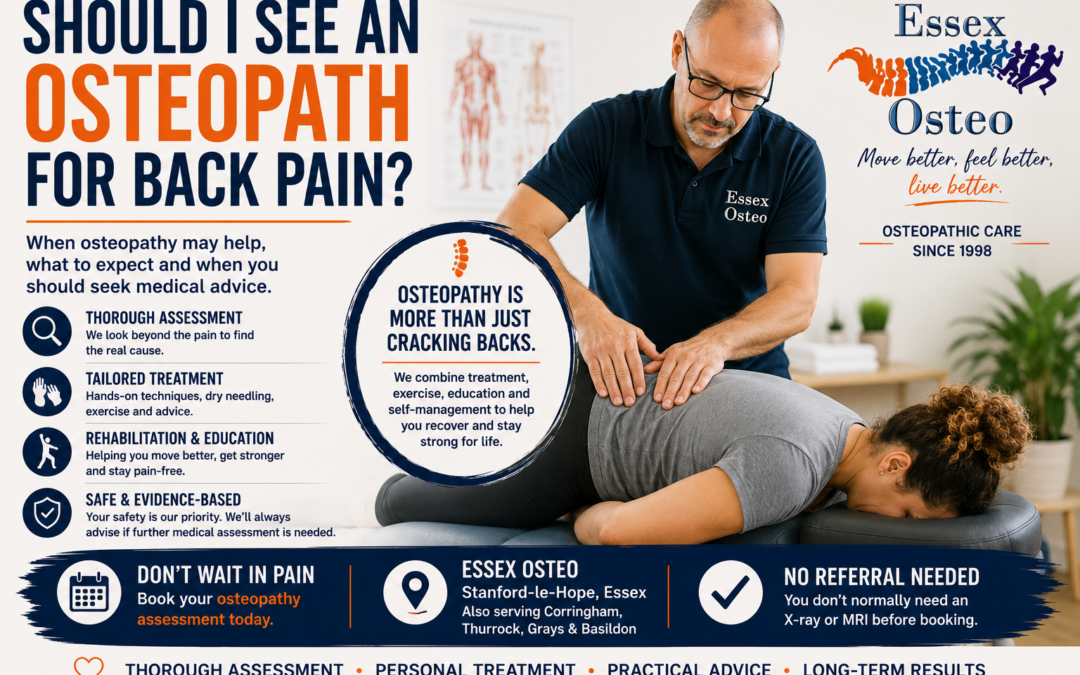
Should I See an Osteopath for Back Pain?
When Osteopathy May Help, What to Expect and When You Should Seek Medical Advice
Lower back pain is one of the most common musculoskeletal problems, and when it strikes, it can be difficult to know who you should see.
Should you visit your GP? See a physiotherapist? Book an osteopath? Do you need an X-ray or MRI first? Or should you simply wait and see whether the pain settles?
For many people with mechanical lower back pain, an osteopath can provide assessment, advice and treatment as part of a wider approach that includes remaining active, exercise and rehabilitation.
At Essex Osteo in Stanford-le-Hope, we’ve been helping people with back pain since 1998. Our approach isn’t simply about “clicking” or manipulating your back. We begin by understanding why you’re experiencing pain, checking that osteopathic treatment is appropriate and developing a treatment and rehabilitation plan around you.
What Does an Osteopath Do for Back Pain?
Osteopaths are healthcare professionals who assess, diagnose and manage musculoskeletal problems affecting areas including the:
- Spine
- Muscles
- Joints
- Ligaments
- Pelvis
- Hips
When you visit an osteopath with lower back pain, treatment shouldn’t begin before understanding your problem.
A comprehensive assessment helps determine:
What is most likely causing your symptoms?
Is there anything that requires further investigation?
Is osteopathic treatment appropriate?
What can you do to help yourself recover?
That assessment is particularly important because not every person with back pain requires hands-on treatment—and occasionally back pain needs medical investigation rather than musculoskeletal treatment.
What Types of Back Pain May an Osteopath Help With?
Osteopaths commonly assess and manage mechanical and musculoskeletal back pain.
This may include symptoms associated with:
Mechanical Lower Back Pain
This is the broad term used for back pain influenced by movement, loading and activity.
Symptoms may include:
- Aching across the lower back
- Pain when bending
- Stiffness after sitting
- Pain getting out of a chair
- Difficulty turning in bed
- Pain following lifting or exercise
Muscle and Joint-Related Back Pain
Back pain can involve muscles, ligaments and spinal joints.
Pain may develop following:
- Unaccustomed activity
- Heavy lifting
- Sport
- Gardening
- Prolonged sitting
- Changes in activity levels
In many cases there isn’t one damaged structure responsible for the symptoms.
Facet Joint Pain
The facet joints are small joints at the back of the spine.
They may contribute to localised lower back pain and stiffness, particularly with certain movements.
We’ve covered this in more detail in our guide to Facet Joint Pain.
Sacroiliac Joint Pain
The sacroiliac (SI) joints connect your pelvis to your sacrum.
SI joint pain may cause discomfort around:
- One side of the lower back
- Buttock
- Pelvis
- Occasionally the groin or upper thigh
Read our guide to Sacroiliac (SI) Joint Pain for more information.
Disc-Related Back Pain
Changes affecting an intervertebral disc can sometimes contribute to back pain.
However, finding a disc bulge or degeneration on an MRI doesn’t automatically mean that the disc is responsible for your symptoms.
Disc changes are extremely common, particularly as we get older.
This is why your examination and symptoms need to be considered alongside any imaging findings.
Can an Osteopath Help Sciatica?
Potentially.
Sciatica describes pain and neurological symptoms caused by irritation or compression of nerves that contribute to the sciatic nerve.
Symptoms may include:
- Pain travelling into the leg
- Tingling
- Pins and needles
- Numbness
- Occasionally weakness
An osteopathic assessment may include testing:
- Muscle strength
- Sensation
- Reflexes where appropriate
- Nerve sensitivity
- Spinal movement
- Hip movement
This helps determine whether conservative treatment is appropriate or whether further investigation is required.
Importantly, not every pain travelling down the leg is sciatica.
Problems involving the hip, SI joint and deep gluteal region can sometimes produce similar symptoms.
Can an Osteopath Help a Slipped Disc?
Many people with disc-related back pain or sciatica can initially be managed conservatively.
A “slipped disc” doesn’t actually slip out of position. The more accurate term is disc herniation or prolapse.
Depending on your symptoms and examination, management may involve:
- Advice about remaining active
- Appropriate hands-on treatment
- Exercise
- Progressive rehabilitation
- Education about your condition
- Monitoring neurological symptoms
Having a disc herniation doesn’t automatically mean you’ll require surgery.
You can read more in our guide to Slipped or Herniated Discs.
Do I Need an X-Ray or MRI Before Seeing an Osteopath?
Usually, no.
Most people with uncomplicated lower back pain don’t require imaging before treatment.
Clinical guidelines recommend against routinely imaging people with non-specific low back pain unless the result is likely to change management.
Your osteopath should first take a detailed history and perform an appropriate physical examination.
Imaging may become appropriate when there is concern about:
- Significant neurological compromise
- Fracture
- Infection
- Cancer
- Inflammatory disease
- Other serious pathology
It may also be considered when specialist procedures or surgery are being contemplated.
We’ve created separate guides explaining:
Do I Need an MRI for Back Pain?
and
Can an X-Ray Diagnose Back Pain?
What Happens at Your First Osteopathy Appointment?
If you’ve never visited an osteopath before, you may understandably be unsure what to expect.
At Essex Osteo, your first appointment begins with a detailed consultation.
We discuss:
- Your current symptoms
- How and when they started
- Previous episodes
- Your medical history
- Medication
- Previous investigations
- Work
- Exercise
- Activities affected by your symptoms
We then carry out an appropriate physical examination.
What Does a Back Pain Examination Involve?
Depending on your symptoms, assessment may include:
- Observing spinal movement
- Lumbar spine examination
- Hip assessment
- Pelvic assessment
- Muscle testing
- Functional movement
- Neurological examination
- Reflex testing where appropriate
- Sensation
- Muscle strength
- Nerve tension testing
The examination isn’t simply about identifying where you’re stiff.
We’re trying to understand the overall clinical picture.
What Treatment Might an Osteopath Use?
There is no single osteopathic treatment for back pain.
Treatment should be tailored to the individual.
At Essex Osteo, depending on your assessment, this may include:
Joint Mobilisation
Gentle repetitive movements may be used to improve joint movement and reduce discomfort.
Manipulation
Spinal manipulation may be appropriate for some patients.
However, not everyone needs or is suitable for manipulation, and it should never automatically be performed simply because you’ve booked an osteopathy appointment.
Soft Tissue Treatment
Massage and other soft tissue techniques may be used to help manage muscle discomfort and improve movement.
Dry Needling
Where clinically appropriate, dry needling may be incorporated into your treatment.
Exercise Rehabilitation
This is an important part of modern back pain management.
Your exercises might target:
- Mobility
- Core strength
- Glute strength
- Hip strength
- General conditioning
- Functional movement
Education and Advice
Understanding your back can be just as important as hands-on treatment.
We’ll discuss:
- What may be causing your symptoms
- What activities you can continue
- What you might temporarily modify
- How to return to exercise
- How to manage flare-ups
Is Osteopathy Just About Manipulation?
No.
This is an important misconception.
Modern osteopathic management can involve a combination of:
assessment + hands-on treatment + exercise + rehabilitation + education + self-management.
Manipulation is simply one possible technique.
At Essex Osteo, treatment is selected according to your diagnosis, preferences, medical history and clinical presentation.
If manipulation isn’t appropriate—or you simply don’t want it—we can use other approaches.
Does Osteopathy Actually Work for Lower Back Pain?
Manual therapy, including spinal manipulation and mobilisation, can provide benefit for some people with low back pain.
However, current clinical guidance generally recommends manual therapy as part of a treatment package that includes exercise, rather than relying on hands-on treatment alone.
This is an important distinction.
The aim shouldn’t be for you to become dependent on repeated treatment.
Instead, hands-on treatment can sometimes help reduce symptoms and improve movement while rehabilitation builds your capacity to manage your back independently.
How Many Osteopathy Sessions Will I Need?
There isn’t a standard number.
Some people with relatively recent uncomplicated back pain may only require a small number of appointments.
Others with:
- Long-standing symptoms
- Recurrent episodes
- Significant deconditioning
- Sciatica
- Complex medical histories
may require a longer period of management and rehabilitation.
We regularly reassess progress rather than simply booking an indefinite course of treatment.
The aim is to make you less dependent on treatment—not more dependent on it.
How Quickly Should Osteopathy Work?
Some people notice improvement following their first few appointments, while others improve more gradually.
Recovery depends on many factors, including:
- How long you’ve had symptoms
- The underlying problem
- Previous episodes
- Activity levels
- Strength and conditioning
- Sleep
- Work demands
- General health
Importantly, improvement isn’t always perfectly linear.
A temporary flare-up doesn’t necessarily mean you’ve damaged your back again.
Our article How Long Does Lower Back Pain Take to Get Better? explains this in greater detail.
Should I Rest After Osteopathic Treatment?
Usually, there’s no need to spend the rest of the day lying down.
For most people with mechanical back pain, maintaining appropriate activity is encouraged.
Depending on your condition, we may suggest:
- Walking
- Gentle mobility
- Specific exercises
- Temporarily modifying strenuous activities
The aim is generally to keep you moving rather than encourage unnecessary rest.
Is Osteopathy Safe?
Osteopathic treatment is generally considered safe when provided appropriately following a suitable assessment.
Temporary reactions can occur after hands-on treatment, such as:
- Mild soreness
- Stiffness
- Tiredness
These usually settle relatively quickly.
More serious complications from manual therapy are uncommon, but no healthcare intervention is entirely without risk.
This is why your medical history, examination findings and individual risk factors should be considered before treatment.
When Should I NOT See an Osteopath First?
Most back pain is musculoskeletal, but some symptoms require medical assessment rather than routine osteopathic treatment.
Seek urgent medical attention if you develop:
🚩 New loss of bladder or bowel control
🚩 Numbness around the genitals, buttocks or inner thighs
🚩 Progressive weakness affecting one or both legs
🚩 Severe back pain following significant trauma
🚩 Back pain accompanied by serious systemic illness
These symptoms can indicate conditions requiring urgent investigation.
Other features such as unexplained weight loss, fever, a history of cancer or persistent unusual symptoms should also be appropriately assessed.
Read our detailed guide:
When Is Back Pain Serious? Red Flags You Should Never Ignore.
Osteopath, Physiotherapist or GP – Who Should I See?
This depends on your symptoms.
Osteopath
An osteopath may be appropriate for assessment and conservative management of uncomplicated musculoskeletal back pain.
Physiotherapist
Physiotherapists also assess and manage musculoskeletal back pain, frequently using exercise, rehabilitation, education and manual therapy.
GP or First Contact Practitioner
Medical or advanced MSK assessment may be appropriate where:
- Medication needs reviewing
- Further investigation may be necessary
- There are unusual symptoms
- Significant neurological problems are suspected
- Specialist referral may be required
There is considerable overlap between modern musculoskeletal professions.
The important factor isn’t simply the professional title—it’s receiving appropriate assessment, evidence-informed treatment and a clear rehabilitation plan.
We’ll explore this further in our next article: Osteopath vs Physiotherapist for Back Pain – Which Should I See?
Should I See an Osteopath If My Back Pain Keeps Returning?
Yes, particularly if recurrent episodes are interfering with your work, exercise or everyday activities.
But the aim shouldn’t simply be to repeatedly treat the painful area whenever symptoms return.
We need to ask:
Why does your back pain keep returning?
Potential contributing factors may include:
- Changes in activity
- Reduced conditioning
- Work demands
- Lifting loads
- Exercise habits
- Previous injuries
- Sleep
- General health
Your management can then focus on improving your ability to tolerate the activities that matter to you.
Can Osteopathy Prevent Back Pain Coming Back?
No treatment can guarantee that you’ll never experience another episode of back pain.
Recurrence is common.
However, improving:
- Strength
- Fitness
- Movement confidence
- Exercise tolerance
- Self-management skills
may help you cope better and reduce the impact of future episodes.
The goal is a stronger, more capable and confident back, rather than trying to create a spine that never experiences an ache.
Why Choose Essex Osteo for Back Pain?
Essex Osteo has been providing osteopathic care in Stanford-le-Hope since 1998.
We regularly assess and treat people experiencing:
- Acute lower back pain
- Persistent back pain
- Sciatica
- Disc-related symptoms
- Facet joint pain
- Sacroiliac joint pain
- Spinal arthritis
- Lumbar spinal stenosis
Our approach combines thorough assessment, evidence-informed hands-on care, exercise rehabilitation and practical advice.
Patients visit our Stanford-le-Hope clinic from Corringham, Thurrock, Grays, Basildon and surrounding areas.
Frequently Asked Questions
Is an osteopath good for lower back pain?
Osteopathy may be helpful for appropriate musculoskeletal lower back pain. Current guidance supports manual therapy as one possible component of a broader programme that includes exercise and self-management.
Should I see an osteopath straight away or wait?
You don’t have to wait until pain has been present for weeks. An earlier assessment may be useful if pain is limiting your activity, you’re concerned about your symptoms or you’re unsure how to manage them.
Can an osteopath treat sciatica?
Osteopaths can assess people with sciatica and may provide conservative management where appropriate. Significant or progressive neurological symptoms may require further medical investigation.
Will an osteopath crack my back?
Not necessarily. Manipulation is only one of many possible treatment techniques. You can also decline any technique you’re uncomfortable with.
Do I need an MRI before seeing an osteopath?
Usually not. Routine imaging isn’t recommended for uncomplicated low back pain unless it is likely to change management.
How many osteopathy appointments will I need?
There is no predetermined number. This depends on your symptoms, diagnosis and progress. Your treatment plan should be reviewed regularly.
Can I exercise while receiving osteopathic treatment?
Usually, yes. Exercise and remaining appropriately active are important parts of managing most types of mechanical back pain.
Can I bring my MRI or X-ray report?
Yes. If you’ve already had imaging, bring the report with you. It can be interpreted alongside your symptoms and clinical examination.
Book an Osteopathy Appointment for Back Pain in Stanford-le-Hope
If you’re experiencing lower back pain and aren’t sure what to do next, Essex Osteo can help.
We’ll assess your symptoms, explain what we think is happening and discuss the most appropriate treatment and rehabilitation options.
And if we identify something that requires medical investigation rather than osteopathic treatment, we’ll tell you.
You don’t need an X-ray or MRI before booking, and you don’t have to wait until your back pain becomes chronic before seeking advice.
Essex Osteo – Stanford-le-Hope
Providing osteopathic care since 1998.
Move better. Feel better. Live better.
SEO Title
Should I See an Osteopath for Back Pain? | Essex Osteo
Meta Description
Should you see an osteopath for lower back pain or sciatica? Learn when osteopathy may help, what treatment involves and when to seek medical advice. Essex Osteo, Stanford-le-Hope.
Suggested URL
/osteopath-for-back-pain/